Category Archives: Second World War

The Mechanised Transport Corps
Part 1: The Early Years

As part of a project looking at honours and awards to some of the women’s services, I came across an article about the award of the Croix de Guerre to British women volunteers of the Mechanised Transport Corps who had served with the French Army during the Battle of France in 1940. Intrigued I did a bit of digging but with little result—most of the available sources online are scanty in their detail and many conflate the various components of the M.T.C. As is often the case, a search of the British Newspaper Archive provided many good leads and those led to a visit to the Library of Congress to read some long-out-of-print memoires. This is the first of four articles about this most interesting volunteer organisation. For details of the honours and awards to the M.T.C. see here.

Edith, Marchioness of Londonderry D.B.E.
Founder of the Women’s Legion.

The Mechanised Transport Corps had its origins in the motor transport section of the Women’s Legion that remained independent after the formation of the Women’s Army Auxiliary Corps in 1917; it served with great distinction in the United Kingdom and then in France after the Armistice. The section continued on a much smaller scale after the war and in 1927 the Women’s Legion Motor Drivers was recognised by the Army Council as a voluntary reserve transport unit and took its place on the Army List, albeit unfunded by the War Office.[1] Throughout the inter-war years, the President of the Women’s Legion Motor Drivers was Lady Londonderry[2] (the founder of the Women’s Legion) and its secretary was Miss B. G. Ward O.B.E.,[3] both of whom had been recognised for their service during the First World War. In 1937 it was renamed Women’s Legion Mechanical Transport Section.

Women’s Legion Motor Drivers, 1918

Prior to the Second World War, in July 1937 Lady Londonderry proposed a ‘new’ Women’s Legion.[4] Beginning as an extension of the Women’s Legion Mechanical Transport Section, it began training in anti-gas drills, first aid, map reading and signalling at Regent’s Park Barracks in November that year. Aged between 18 and 40, its members were required to have a clean driving licence, paid a subscription upon enrolment and purchased their own uniforms. The unit established at Regents Park became No. 1 Company and was led by Mrs. G. M. Cook O.B.E., a driving force behind the transport section in the earlier war.[5] Early success led to a plan in January 1938 to expand the organisation to provide many more women capable of driving commercial transport in the event of a national emergency and recruitment soon began in earnest. Miss Ward commented, ‘There is no difficulty in finding women who can drive lorries… they are quite capable of driving large ambulances and lighter lorries. During the war they did it and they would be able to do it again.’[6]

Mrs. G. M. Cook O.B.E
Corps Commandant, Mechanised Transport Corps

Continue reading

Operation Varsity, The Rhine Crossing—
Royal Signals & United States 17th Airborne Division

(Update March 2025: This article has been updated to include more information about the fate of the various crew members and passengers and to add more photographs, including that of Signalman Teddy Beddington, which was provided by his nephew.)

(Update June 2026. This article has been rewritten to reformat it and to include additional detail. It can be read in the summer 2026 edition of The Journal published by the Royal Signal institution.)

1st Lieutenant Arnold L. Holt

Operation Varsity was the airborne component of the Rhine crossing (Operation Plunder) conducted by United States XVIII Corps (Airborne) that sought to capture the Diersfordter Wald between Hamminkeln and Wessel and seize crossings over the River Issel. On 24 March 1945, the British 6th Airborne Division landed by parachute and by glider at drop zones and landing zones at Hamminkeln in the north of the area and the United States 17th Airborne Division landed in the south, north of Wessel. A query posed to me by the grandson of Lieutenant Arnold L. Holt, 61st Troop Carrier Squadron, United States Army Air Forces created a route to a treasure trove of information from various sources that allows a more complete story to be told of the fate of the men of the Royal Corps of Signals serving with 17th Airborne Division.

Detachments of Royal Signals soldiers from 1st Airborne Corps Signals attached to No. 2 Air Support Signal Unit were landed by glider to support both divisions.[1] The use of British signallers by 17th Airborne Division was necessitated by the use of the British Second Tactical Air Force[2] for close air support. The No. 2 A.S.S.U. ‘tentacles’ (radio detachments) provided links from both divisions to Headquarters Second Army and to the Group Control Centres of Second Tactical Air Force for tasking. Separately, No. 2 A.S.S.U. provided a radio detachment at Headquarters XVIII Corps at Xanten. Continue reading

A Combined British-United States Grave at Digboi War Cemetery, Assam

This is one of several posts following my recent trip to India. See the posts about the CWGC cemeteries at Kolkata, Kohima and Digboi.

Digboi War Cemetery, Assam

In Digboi War Cemetery in north-east Assam lies the remains of a sergeant of the United States Army Air Forces. He is interred in a single grave with three British soldiers. Why they lie together is a most interesting tale; the remains of all four men made journeys of many thousands of miles before their final burial at Digboi.[1]

Douglas C-47 Skytrain in the India-Burma Theatre

On the morning of 7 August 1944, United States Army Air Forces Douglas C-47 Skytrain, serial 42-93341, from 9th Combat Cargo Squadron, 3rd Combat Cargo Group departed Moran airfield in Assam on an airdrop sortie to Burma. After completing its drop, in very low cloud the aircraft crashed into a hill four miles west of Warazup (Waura Zup, Myanmar) just before 11.00am. The aircraft had on board four United States and three British crew; the latter were men of the Royal Artillery serving as air despatchers. All three had been members of 122nd (The Royal Warwickshire Regiment) Light Anti-Tank/Anti-Aircraft Regiment Royal Artillery in 36th Division prior to being posted to an air despatch company when that regiment was reorganised.[2]

All of the crew of 42-93341 were killed:

Pilot: T/2733 Flight Officer Wyant Vanden Mecham, United States Army Air Forces.
Co-Pilot: O-715155 Second Lieutenant Walter Eugene Davis, United States Army Air Forces.
Radio Operator: 16021900 Sergeant Robert Stanley Mercier, United States Army Air Forces.
Aerial Engineer: 31115894 Sergeant Arnold Sulo Oja, United States Army Air Forces.
Air Despatcher: 5104546 Sergeant John Pitt, Royal Regiment of Artillery.
Air Despatcher: 11425253 Gunner Frank Baines, Royal Regiment of Artillery.
Air Despatcher: 1538730 Gunner Wilfred Downton, Royal Regiment of Artillery.

A cursory examination of the Commonwealth War Graves Commission records would indicate that the remains of Sergeant Oja and the three British air despatchers were reinterred at Digboi from Panitola Military Cemetery in 1946, but that is far from the complete story. Continue reading

Digboi War Cemetery

This is the third short post about Commonwealth War Graves Commission cemeteries visited during a recent visit to India with ‘The Forgotten War Tour’ led by Dr. Robert Lyman MBE and organised by Bertie Alexander of Sampan Travel. (See the posts about Kolkata and Kohima). It includes details about the two Royal Signals soldiers buried in the cemetery and information about several others that I found interesting, including a nurse, a soldier from the Belgian Congo, an Italian NCO, and an NCO of the United States Army Air Forces.

Digboi War Cemetery, Assam

Digboi is in the north-eastern corner of Assam, near the Burmese border and on the road to Ledo, the start-point of the Ledo Road (the Stillwell Road) that linked Assam to the Burma Road and thence to China in the latter part of the Second World War.

Construction of the Ledo Road began in December 1942. It led over the Pangsau Pass into Burma and south to join the Burma Road at Mong Yu near the Chinese border. Digboi was on the line of communication to Ledo and a military hospital was established there. After the war the cemetery was added to by burials brought in from Panitola, Jorhat, Margherita, Tinsukia and Ledo, and a single grave from the United States cemetery at Shingbwiyang (Captain D. A. K. Homan, Indian Armoured Corps). The original site of the cemetery was damaged during an earthquake in 1950 and later landslides further endangered the graves. The cemetery was moved to its present location in mid-1959. The cemetery now contains 197 Commonwealth burials and one Belgian, one Italian and one United States burial, all from the Second World War.

There are two Royal Signals soldiers buried in the cemetery: Continue reading

Kohima War Cemetery

This is the second short post about Commonwealth War Graves Commission cemeteries visited during a recent visit to India with ‘The Forgotten War Tour’ led by Dr. Robert Lyman MBE and organised by Bertie Alexander of Sampan Travel. (See the posts about Kolkata and Digboi).

Kohima War Cemetery was constructed on the site of the terraced grounds of the residence of the Deputy Commissioner[1] of the Naga Hills, on the slopes below what became known as Garrison Hill during the Battle of Kohima.

The cemetery was designed by C. St. C. R. Oakes, an Advisory Architect to the Imperial War Graves Commission (later Principal Architect) who had served with 72nd Infantry Brigade in the Arakan, for which he had been appointed an M.B.E.[2] A unique aspect of its design was the incorporation of the Deputy Commissioner’s tennis court, around which fierce fighting had taken place in April and May 1944.

The Cross of Sacrifice and the Tennis Court

The inscription inside the shelter at the base of the Cross of Sacrifice reads:

HERE AROUND THE TENNIS COURT OF THE DEPUTY COMMISSIONER LIE MEN WHO FOUGHT IN THE BATTLE OF KOHIMA IN WHICH THEY AND THEIR COMRADES FINALLY HALTED THE INVASION OF INDIA BY THE FORCES OF JAPAN IN APRIL 1944

Buried here are 1,420 Commonwealth war dead, of whom 125 are unidentified. A further 917 Hindu and Sikh soldiers who were cremated in accordance with their faith are commemorated on the Kohima Cremation Memorial

The Cremation Memorial

The missing from the battles in the region are amongst those commemorated on the Rangoon Memorial.[3]

There are eight Royal Signals all ranks buried at Kohima, five of who were killed during the battle, and three who died in hospital in Kohima or elsewhere in the region at other times:

3603687 Signalman FRED HOUGHTON BOYD
2nd Divisional Signals
Killed in action on 12 June 1944 during the latter stages of the Battle of Kohima. Continue reading

Commemorating Royal Signals War Dead – New Page, ‘K’

The Royal Signals casualties whose surnames begin with ‘K’ have now been included on the War Dead page on this website (the document opens as a pdf). The 118 casualties include 34 who were killed in action or died of wounds (the most recent being Sergeant B. R. Keen, 14th Signal Regiment (Electronic Warfare), who was killed in action in Afghanistan in 2007), and 23 men who died as prisoners of war in the Second World War. As is the case across all of these pages over 12.5% of fatal casualties occurred in road traffic accidents, a figure that increases in the modern era reflecting the advances in medical care that reduce the number dying of disease.

Brookwood 1939-1945 Memorial © CWGC
Commemorated on the memorial to the missing of the Second World war are:
Company Quartermaster Serjeant Albert Horace Kemp, 8th Anti-Aircraft Brigade Signal Section, killed with his family at Merstham near Reigate in a bombing raid on 19 April 1941; their remains were never found.
Captain Oliver Cecil Kisch, Air Formation Signals, killed in action and lost at sea on 17 June 1943 when the troopship SS Yoma was sunk on route from Tripoli to Alexandria.
Signalman Robert Wilson Kerr, who drowned in the Firth of Forth on 16 October 1946.

HMS Bulolo—No. 1 Ship Signal Section, 1942-1945 (Part 2)

Part 1 of this tale covered the period from the formation of No. 1 Ship Signal Section in 1942 until the arrival of HMA Bulolo in Bombay (Mumbai) in September 1943.

HMS Bulolo

HMS Bulolo’s deployment to the Far East in the latter part of 1943 was in preparation for amphibious operations in the late spring of 1944 against Japanese-occupied Sumatra and Malaya (Operation Culverin) and against the Andaman Islands (Operation Buccaneer). The plans were ultimately abandoned but not before No. 1 Ship Signal Section had spent time passing on its experience to new signal sections of the newly-formed 218 Signal Assault Wing.[1] In October, Bulolo took part in a command post exercise with the staff of 33rd Indian Corps (Exercise Otter) that simulated a divisional landing, with the staff from 36th Indian Division and 29th Infantry Brigade on board HMS Keren—the former being described as, ‘completely satisfactory’ but the latter (i.e. embarked division and brigade headquarters) as, ‘a complete failure’.[2] A similar event (Exercise Swordfish) was conducted with 2nd Division the following month, by which time the lessons had been learned and communications were much improved. A third exercise was cancelled in mid-December and Bulolo was ordered back to the Mediterranean. After spending Christmas at Bombay, she sailed for Italy via the Suez Canal.

Bulolo arrived at Naples on 12 January 1944 and immediately embarked Lieutenant Colonel L. T. Shawcross, commanding officer of 1st Divisional Signals. The division had been allocated to United States VI Corps as one of the two assaulting division for Operation Shingle—an amphibious landing at Anzio. The divisional staff and additional signallers embarked over the following days and on 18 January an exercise was carried out in the Salerno area. On 20 January, an interoperability exercise took place with the headquarters ship USS Biscayne, the flagship for the operation, and the following day the assault force sailed for Anzio.[3] The landings were largely unopposed and, from the perspective of the signal section, somewhat routine. The divisional staff disembarked on 23 January and the following day, in the midst of an air attack, Bulolo sailed for Naples and thence to Malta. March 1944 was spent in Algiers and on 7 April the ship’s company prepared to depart the Mediterranean. Prior to sailing a signal was received from Commander-in-Chief Mediterranean that read: ‘Whilst on Mediterranean Station you have played a very active part in operations and may be justly proud of your share in our successes. Goodbye and good luck to you and your ship’s company’. Continue reading

HMS Bulolo—No. 1 Ship Signal Section, 1942-1945 (Part 1)

In the Summer 2019 edition of the Journal of the Royal Signals Institution, John Young wrote an excellent short history of 661 Signal Troop (LPD). I was prompted to write something about the troop’s predecessor and where it all began—No. 1 Ship Signal Section on HMS Bulolo during the Second World War. The article (somewhat bizarrely attributed to Captain Neil Donaghy, who in fact wrote the update about Project Caduceus) was published in the Journal but (due to another editing error) that version was incomplete and missing its footnotes and some illustrations. The story is told here in two parts…

No. 1 Ship Signal Section was formed aboard HMS Bulolo at Chatham on 16 June 1942.[1] Arising out of the growing understanding of the requirements for effective command of amphibious landings, most importantly the need for a combined[2] headquarters afloat (a lesson learned on Operation Menace—the ill-fated attack on Dakar in 1940), HMS Bulolo was the first of several ships to be converted into a Landing Ship, Headquarters.[3] Designed as a passenger, general cargo and mail steamer, the 6,500-ton ship had piled her trade in the south Pacific for less than a year before war broke out in Europe. Bulolo was requisitioned in September 1939 and converted into an armed merchant cruiser, in which guise she worked as a convoy escort in the Atlantic until being bought by the Admiralty in March 1942.

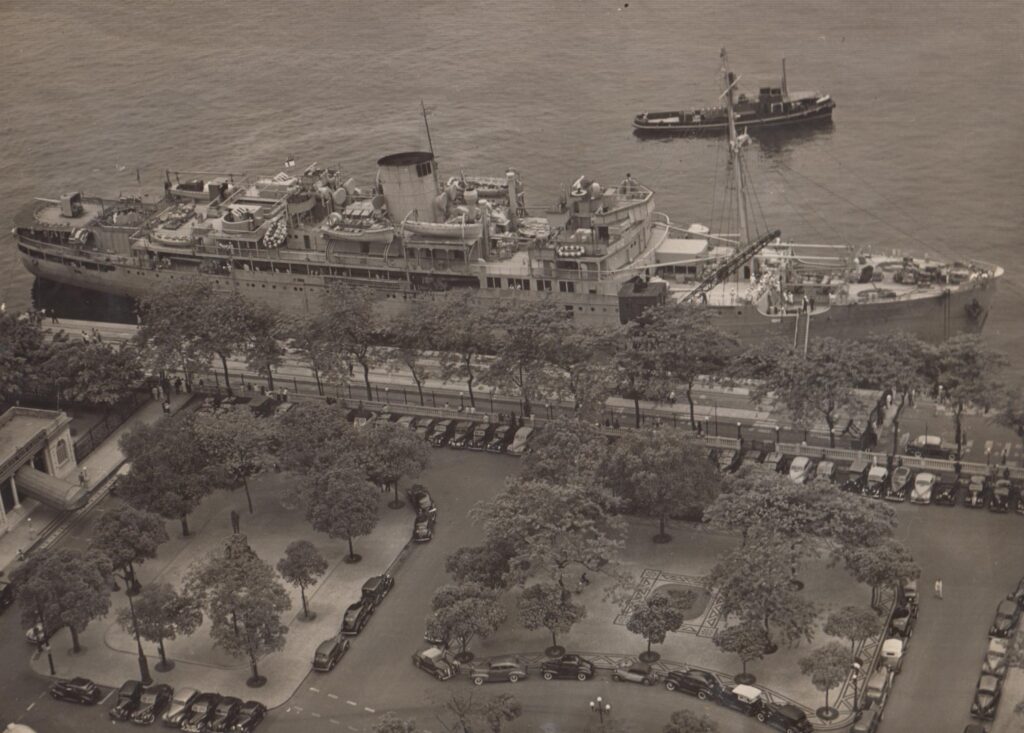
HMS Bulolo alongside in Rio de Janeiro on 24 November 1941. The placement of her original fit of seven 6-inch guns can be clearly seen—two forward below the bridge, two either side under the upper decks and one aft. The two 3-inch anti-aircraft guns can be seen towards the rear of the upper deck. This weapon fit was changed significantly when Bulolo became a headquarters ship. Compare with the photograph in Part 2 of the damage suffered in June 1944.

There then followed an extensive period of refitting—the forward cargo hold being converted into a three-deck suite of headquarters staff spaces and communications centres—which was completed that summer and by which time the conversion of a second ship, HMS Largs, had begun.[4] For most of this period, and for the period described here, HMS Bulolo was commanded by Captain R. L. Hamer DSO, the father of Lieutenant Colonel J. R. Hamer, Royal Signals.[5]

Continue reading

Sergeant Henry James ‘Harry’ May, 2nd Divisional Signals, Burma

The Mention in Despatches is arguably the United Kingdom’s oldest form of recognition for gallantry or meritorious service on operations. The inclusion of the names of those worthy of being brought to the attention of the Admiralty or War Office became well-established in the 19th Century. An excellent, early example is the ‘mention’ of Serjeant Moore of His Majesty’s 86th Regiment of Foot for his leadership of a forlorn hope in the assault at Bharuch on 29 August 1803 during the Second Anglo-Maratha War, which appeared in the London Gazette in April 1804.[1]

Unfortunately, in the modern era these awards are the most difficult to research. Even with information from a recipient’s family, service records and unit war diaries, the reason for the majority of mentions is impossible to determine.

During my research into Royal Signals honours and awards (there have been around 6,200 Mentions in Despatches to personnel of the Corps), I was contacted by the family of a Royal Signals sergeant who was mentioned for his conduct during the Burma campaign in the Second World War. Notwithstanding the wealth of information about him, we have been unable to track down any details of his award but his story is worth telling.

Corporal Henry James ‘Harry’ May before sailing for India

Harry May was born in Glasgow on 22 August 1913. He worked as a clerk and he was a pre-war Territorial Army solder. He had enlisted on 20 April 1939, just after the announcement that the Territorial Amy would be doubled in size, and joined 52nd (Lowland) Divisional Signals. He attended summer camp just prior to the outbreak of war, and was mobilised on 2 September and posted to the newly reformed 15th (Scottish) Division. By trade he was an ‘operator wireless and line’, an ‘OWL’. In April 1940, he was promoted to lance corporal and a bit over a month later to corporal. In June he was posted to No. 1 Company, 2nd Divisional Signals; it was with this unit that he would see out the rest of the war. Continue reading

The Hong Kong Signal Company and the SS Lisbon Maru

This blog post originally appeared on my website dealing with Royal Signals honours and awards. With the closure of that site I have updated it and moved it here.

It is written in memory of the officers and men of Royal Signals who died during the sinking of the SS Lisbon Maru eighty years ago on 2 October 1942, and of those others who were killed in action during the Battle for Hong Kong or who later died as prisoners of war.

USS Grouper

Before dawn on 1 October 1942 off the small islands at the eastern extremity of the Zhoushan archipelago near Shanghai, Lieutenant Commander Rob Roy McGregor, United States Navy, commanding the submarine USS Grouper, spotted a perfect target—a Japanese freighter of about 7,000 tons. Having delayed his attack until just after daylight, McGregor fired a first salvo of three torpedoes; all missed. A fourth hit the freighter’s stern and she hove to. Sometime later, seeing that she was not sinking, McGregor fired a fifth torpedo and then a sixth, which also missed. Grouper had now been spotted, however, and under attack she made a run for safety.[1]

The freighter was the SS Lisbon Maru, a 22-year-old general cargo ship converted to carry a human cargo. On board were 1,834 prisoners of war from Hong Kong and 780 Japanese soldiers. Continue reading