
This is one of several posts following my recent trip to India. See the posts about the CWGC cemeteries at Kolkata, Kohima and Digboi.

Digboi War Cemetery, Assam
In Digboi War Cemetery in north-east Assam lies the remains of a sergeant of the United States Army Air Forces. He is interred in a single grave with three British soldiers. Why they lie together is a most interesting tale; the remains of all four men made journeys of many thousands of miles before their final burial at Digboi.[1]

Douglas C-47 Skytrain in the India-Burma Theatre
On the morning of 7 August 1944, United States Army Air Forces Douglas C-47 Skytrain, serial 42-93341, from 9th Combat Cargo Squadron, 3rd Combat Cargo Group departed Moran airfield in Assam on an airdrop sortie to Burma. After completing its drop, in very low cloud the aircraft crashed into a hill four miles west of Warazup (Waura Zup, Myanmar) just before 11.00am. The aircraft had on board four United States and three British crew; the latter were men of the Royal Artillery serving as air despatchers. All three had been members of 122nd (The Royal Warwickshire Regiment) Light Anti-Tank/Anti-Aircraft Regiment Royal Artillery in 36th Division prior to being posted to an air despatch company when that regiment was reorganised.[2]
All of the crew of 42-93341 were killed:
Pilot: T/2733 Flight Officer Wyant Vanden Mecham, United States Army Air Forces.
Co-Pilot: O-715155 Second Lieutenant Walter Eugene Davis, United States Army Air Forces.
Radio Operator: 16021900 Sergeant Robert Stanley Mercier, United States Army Air Forces.
Aerial Engineer: 31115894 Sergeant Arnold Sulo Oja, United States Army Air Forces.
Air Despatcher: 5104546 Sergeant John Pitt, Royal Regiment of Artillery.
Air Despatcher: 11425253 Gunner Frank Baines, Royal Regiment of Artillery.
Air Despatcher: 1538730 Gunner Wilfred Downton, Royal Regiment of Artillery.
A cursory examination of the Commonwealth War Graves Commission records would indicate that the remains of Sergeant Oja and the three British air despatchers were reinterred at Digboi from Panitola Military Cemetery in 1946, but that is far from the complete story.
Very soon after the crash, an aircraft from Warazup found the site but its crew were unable to identify the aircraft, which had burned up. A ground search party from Warazup was unsuccessful in its initial search because of the extremely dense jungle but a subsequent search party recovered the remains of the crew.
In an arrangement between the United Kingdom and the United States, the nation with the majority of casualties in a single air crash was responsible for the burial and maintenance of the single grave—a good example is the grave of Major General Orde Wingate at Arlington National Cemetery in Washington D.C.
If buried together, this group of casualties from 42-93341 would have remained the responsibility of the United States but, given later events, it seems that three of the casualties (Mecham, Davis and Mercier) were identifiable while those of Oja, Pitt, Baines and Downton were inseparable and unidentifiable. In consequence, Sergeant Oja, Sergeant Pitt and Gunners Baines and Downton were buried together in the Commonwealth cemetery at Panitola (Plot 1, Row 2, Grave 5) on 25 August 1944. It is logical to assume that Flight Officer Mecham, Second Lieutenant Davis and Sergeant Mercier were interred at the same time the United States cemetery at Panitola.
The concentration and repatriation of United States burials in India is a somewhat convoluted story of proposal and counter proposal as the work was undertaken but, in short, it was planned that some 2,500 remains from 40 different locations would be moved to four concentration cemeteries at New Malir east of Karachi (now in Pakistan), at Barrackpore and Kalaikunda in India (15 miles north and 80 miles west of Kolkata, respectively), and at Myitkyina in Burma. In the event, burials at New Malir (and those destined for that site) were concentrated at Barrackpore.[3] In parallel, final searches were made for men in isolated graves and at aircraft crash sites.
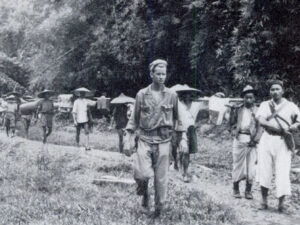
Search unit embarks on a 4-day mission into Burmese jungles to
recover 13 Air Corps men killed in action during January 1945
In December 1945, the United States cemetery at Panitola was cleared by men from 970th Quartermaster Supply Detachment and the 366 sets of remains, including Mecham, Davis and Mercier, were transported by air to Kalaikunda.
The following year, when the Commonwealth cemetery at Panitola was cleared, the remains of Sergeant Oja and the three British soldiers were reinterred in a single grave at Digboi War Cemetery on 26 October 1946 (Plot 2, Row D, Grave 5-8) and reinterred again in a common grave at that site on 17 February 1947 when the cemetery was reorganised (Plot 3, Row E, Grave 1 & 2).
In the course of 1947 the remains of United States personnel in British cemeteries in Indian and Burma were exhumed and moved to Barrackpore and the remains of Oja, Pitt, Baines and Downton were taken from Digboi—as it turns out, contrary to the agreement regarding inseparable remains and resulting in later negotiation for their return.
In early 1947, plans were made to exhume all of the United States burials at Kalaikunda and Barrackpore and return them to the United States. Until repatriated by sea to Hawaii, all of the remains were to be stored in a purpose built mausoleum at Barrackpore. Work began at Kalaikunda on 15 September 1947 and at Barrackpore on 30 October. By late November the work was complete, once more reuniting the crew of 42-93341 in a single place, if not actually together. In January 1948 the 3,500 or so sets of remains at Barrackpore were transported by the Liberty Ship USAT Albert M. Boe to a mausoleum in Honolulu.
In Hawaii, construction of the Punchbowl Cemetery (National Memorial Cemetery of the Pacific) started in August 1948. Interments began on 4 January 1949 after the completion of initial subterranean work and this first phase of burials was completed by the end of March. A second phase of interment began on 13 June and was complete 10 days later. The cemetery was opened to the public in July and it was dedicated on 2 September 1949.
So what of the crew of 42-93341?
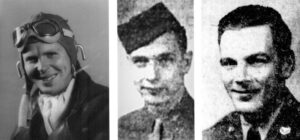
Flight Officer W. Vanden Mecham (left),
Second Lieutenant Walter E. Davis (centre) &
Sergeant Robert S. Mercier
Two were repatriated from Hawaii in 1948 according to the wishes of next of kin: Second Lieutenant Walter E. Davis was buried on 22 June 1948 at Knoxville National Cemetery, Tennessee. He is commemorated on the East Tennessee Veterans Memorial. Sergeant Robert S. Mercier was buried on 3 September 1948 at the Gardens of Rest Cemetery in Wells, Delta County, Michigan.
Flight Officer W. Vanden Mecham was reinterred on 13 June 1949, the first day of the second phase of burials at the National Memorial Cemetery of The Pacific, Hawaii.
The inseparable remains of Sergeant Oja and the three British air despatchers were held together at Punchbowl Cemetery. Negotiations between the Foreign Office and the State Department for the return of these remains to Digboi began at some time in 1949 or 1950. In August 1950 confirmation was received that the United States Department of the Army would accept responsibility for the transfer of the remains and they were duly flown to India. On 10 March 1951 the remains of the four men were reinterred at Digboi War Cemetery in the plot from which they had been removed in 1947.[4] The original site of the cemetery had been damaged during an earthquake in 1950 and later landslides further endangered the graves. When Digboi War Cemetery was relocated to its present site to the east of the town on the Digboi-Pengeri Road, Sergeant Oja, Sergeant Pitt, Gunner Baines and Gunner Downton began their final journey. The remains of the four men were reinterred in the new cemetery on 6 July 1959 (Plot 4, Row L, Grave 3-6).
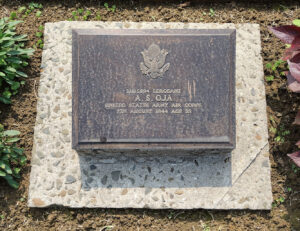
The grave marker for Sergeant Arnold S. Oja, Digboi War Cemetery
31115894 Sergeant ARNOLD SULO OJA, United States Army Air Forces. Arnold Oja was born in New York on 28 October 1920 and lived in Weathersfield, Windsor County, Vermont prior to the war where he worked for Cone Automatic Machine Co. in a machine shop. He enlisted on 11 July 1942. He is commemorated on the Weathersfield Roll of Honor at the Weathersfield Veterans Memorial in Perkinsville, Vermont.
5104546 Sergeant JOHN PITT, Royal Regiment of Artillery. John Pitt was born on 4 January 1913. He and his wife Lily lived at Great Barr, Birmingham. He is commemorated in the Book of Remembrance in the Birmingham Hall of Memory. HE GAVE HIS TO-DAY FOR OUR TO-MORROW
11425253 Gunner FRANK BAINES, Royal Regiment of Artillery. Frank Baines was born in Barnsley, South Yorkshire in 1922. He is commemorated on his father’s grave at Dodworth Cemetery in Barnsley and his name is inscribed on the Dodworth War Memorial. GOD BE WITH YOU TILL WE MEET AGAIN. MAM AND DAD
1538730 Gunner WILFRED DOWNTON, Royal Regiment of Artillery. Wilfred Downton was born on 5 May 1918 at Stourbridge, Worcestershire. He is commemorated on the memorial at Old Swinford Hospital School and his name is inscribed on the Stourbridge War Memorial. IN PROUD MEMORY OF OUR DEAR BROTHER WILFRED, SO SADLY MISSED. WE WILL REMEMBER HIM
Acknowledgements:
The photo of Second Lieutenant Walter E. Davis was provided by the East Tennessee Veterans Memorial organisation.
1. (Back) The CWGC cemetery information for Digboi records that a single grave was moved from the United States cemetery at Shingbwiyang. Some accounts link this to Sergeant Arnold S. Oja. It was, in fact, Captain D. A. K. Homan, Indian Armoured Corps who died on 23 November 1944.
2. (Back) For commentary about air supply in this period see the Despatch by Air Chief Marshal Sir Keith Park K.C.B., K.B.E., M.C., D.F.C., Allied Air Commander-in-Chief, Air Command, South East Asia (London Gazette 12 April 1951 (39196)) and for a description of the evolution of air supply during the latter part of the Burma Campaign see the Despatch by Lieutenant General Sir Oliver Leese, Bart., K.C.B., C.B.E., D.S.O., Commander-in-Chief, Allied Land Forces, South-East Asia (London Gazette 12 April 1951 (39195)).
3. (Back) For a complete and most detailed description of this process in India/Burma see Steere, E. and Boardman, T. M. (1957). Final Disposition of World War II Dead, 1945-51. Washington D.C.: Historical Branch, Office of the Quartermaster General—Chapter XIII, Concentration Operations in the Pacific and Asia, pp. 434-441; and Chapter XIV, Search and Recovery Operations in Pacific Ocean Areas and on the Asiatic Mainland, pp. 484-489.
4. (Back) Reburial in Digboi War Cemetery, Assam of group of remains formerly held in Hawaii by Dept of the Army. Memo from U.S. Consul General, London to Department of State dated 12 April 1951.
Thanks Nick,
A great piece of investigation which I am sure will be appreciated by the families of the deceased.
Best wishes,
Mike
Interesting read Nick , thank regards Paul
Thank you!