
This is the third short post about Commonwealth War Graves Commission cemeteries visited during a recent visit to India with ‘The Forgotten War Tour’ led by Dr. Robert Lyman MBE and organised by Bertie Alexander of Sampan Travel. (See the posts about Kolkata and Kohima). It includes details about the two Royal Signals soldiers buried in the cemetery and information about several others that I found interesting, including a nurse, a soldier from the Belgian Congo, an Italian NCO, and an NCO of the United States Army Air Forces.

Digboi War Cemetery, Assam
Digboi is in the north-eastern corner of Assam, near the Burmese border and on the road to Ledo, the start-point of the Ledo Road (the Stillwell Road) that linked Assam to the Burma Road and thence to China in the latter part of the Second World War.
Construction of the Ledo Road began in December 1942. It led over the Pangsau Pass into Burma and south to join the Burma Road at Mong Yu near the Chinese border. Digboi was on the line of communication to Ledo and a military hospital was established there. After the war the cemetery was added to by burials brought in from Panitola, Jorhat, Margherita, Tinsukia and Ledo, and a single grave from the United States cemetery at Shingbwiyang (Captain D. A. K. Homan, Indian Armoured Corps). The original site of the cemetery was damaged during an earthquake in 1950 and later landslides further endangered the graves. The cemetery was moved to its present location in mid-1959. The cemetery now contains 197 Commonwealth burials and one Belgian, one Italian and one United States burial, all from the Second World War.
There are two Royal Signals soldiers buried in the cemetery:

4614116 Signalman HARRY BROWN
Eastern Command Signals
At about 11.00pm on 23 October 1943, a powerful earthquake in northern Assam badly damaged buildings and other infrastructure in the region. Signalman Brown was crushed by a falling building in Jorhat and died of his injuries on 24 October 1943, aged 30.[1]
LOVING AND TREASURED MEMORIES OF HARRY OUR DEAR SON & BROTHER.
MEMORIES NEVER DIE
Originally buried in the Christian plot at Jorhat Military Cemetery, his remains were reinterred on 12 October 1946 at Digboi War Cemetery.
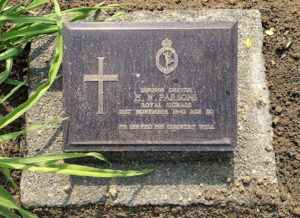
2592998 Driver HAROLD NORMAN PARSONS
67th (York and Lancaster) Heavy Anti-Aircraft Regiment Royal Artillery Signal Section
in 9th Anti-Aircraft Brigade[2]
Died of disease/natural causes on 21 November 1942 in hospital at Panitola, aged 30.
HE SERVED HIS COUNTRY WELL
Originally buried Panitola Military Cemetery, his remains were reinterred on 12 October 1946
at Digboi War Cemetery.
Also buried here are:

209451 Sister CONSTANCE DOTEREL MARY WORT
Queen Alexandra’s Imperial Military Nursing Service.
General Hospitals were established in Digboi, Dibrugarh, Panitola and Margherita to cater for the labour construction force in northern Assam and the large military presence that provided the huge logistic endeavour of the Allies in support of the Chinese war effort and the Allied advance into in Burma. Sister Wort is the only woman buried in the cemetery at Digboi, indeed she is one of only three women buried east of Kolkata, the others being nurses interred at Imphal and Kohima.[3] She was serving at No. 45 Indian General Hospital (Combined) (having previously served at No. 14 British General Hospital in Comilla) when she fell seriously ill in April 1945; she died from acute appendicitis on 1 May 1945, aged 33. Her grave marker is inscribed AT THE GOING DOWN OF THE SUN, AND IN THE MORNING WE WILL REMEMBER THEM. “UNTIL”

116472 Sergente ANTONIO RESPANTI
Royal Italian Army (Regio Esercito)
Sergente Antonio Respanti, who died on 30 July 1944, is the only Italian casualty to lie in a Commonwealth War Graves Commission cemetery in South Asia. His marker is inscribed MORTO PER LA PATRIA. He was born on 17 August 1920 in Firenzuola in Tuscany and is commemorated by the Italian Ministry of Defence as ‘Antonio Raspanti’.
During the Second World War, a prisoner of war camp for Italian troops captured in East and North Africa was located at Ramgarh north of Ranchi. It was one of 29 such camps across India that housed over 68,000 Italian prisoners of war. Following the Armistice with Italy in September 1943, some former Italian prisoners of war were employed as labourers in northern Assam in the construction and maintenance of airfields and on the Ledo Road.
The majority of the 500 or so Italian prisoners and former prisoners who died in India between 1941 and 1947 were reinterred in 1953 at the Italian military shrine (Sacrario Militare Italiano) at Sewri Cemetery, Mumbai, which was opened in 1954. On niches either side of the alter are plaques inscribed with the name, date and place of death of each casualty. The reason for Sergente Respanti’s grave remaining in Digboi is unknown.

K/0708 Soldat BOLONGO
10th (Belgian Congo) Casualty Clearing Station, Force Publique du Congo Belge
Mobilised as part of the Force Publique, the gendarmerie of the Belgian Congo, 10th (Belgian Congo) Casualty Clearing Station left Léopoldville for Nairobi in November 1940 to join the East Africa Force. It was staffed with six Belgian doctors, 10 other Belgian personnel, and 82 Congolese medical assistants, orderlies, and drivers. The lingua franca for the unit for all personnel was French. It would remain in support of East African forces through the operations in Madagascar, and later in Burma in support of 11th (East African) Division. During the operations in Burma in 1944, the casualty clearing station was at Palel before moving forward to Moreh.
In December 1944 the division, including 10th (Belgian Congo) Casualty Clearing Station, moved to Bokajan near Golaghat in Assam to rest and refit. Soldat Bolongo is one of two Congolese soldiers commemorated by the Commonwealth War Graves Commission in South Asia.[4] He died on 8 January 1945; the circumstances of his death are unknown. It is likely that his remains were moved to Digboi when the cemetery at Jorhat was cleared. His marker is inscribed PATRIA MEMOR.
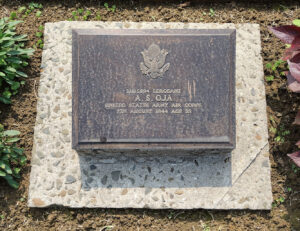
31115894 Sergeant ARNOLD S. OJA
9th Combat Cargo Squadron, United States Army Air Forces
Arnold Oja was born in New York on 28 October 1920 and lived in Windsor, Vermont prior to the war where he worked in a machine shop for Cone Automatic Machine Co. He was killed in an air crash in Burma on 7 August 1944 and is the only member of the United States forces to be commemorated by the Commonwealth War Graves Commission in South Asia. He is buried alongside three Royal Artillery air despatchers who were killed in the same crash—Sergeant John Pitt and Gunners Frank Baines and Wilfred Downton. How the remains of all four men made journeys of many thousands of miles before their final burial at Digboi is a most interesting tale.
This is an immaculate cemetery, beautifully maintained by the head gardener, Mr. Pratapboro.

[1] The amended casualty report records his death as occuring on 23 October, as does his casualty card.
[2] Headquarters 9th Anti-Aircraft Brigade was based in Panitola; the brigade was responsible for the air defence of Assam.
[3] 209979 Sister Ethel Carther, Territorial Army Nursing Service, who was murdered (strangled by person unknown) on 19 February 1944, is buried at Kohima War Cemetery. She was a 1938 recipient of the Alice Long Memorial Medal for General Proficiency from Norfolk and Norwich Hospital. (Note that Sister Carter’s number was incorrectly recorded by the CWGC as ‘269979’ in the cemetery register and online; it has now been corrected on the online commemoration.)
1236 Nurse Edith Florence Turner, Auxiliary Nursing Service (India), who died on 4 September 1943, is buried at Imphal War Cemetery.
[4] The other casualty is 18056/2 Soldat A. Lulanga, 10th (Belgian Congo) Casualty Clearing Station, Force Publique du Congo Belge who died on 29 March 1945 and is buried at Mainamati War Cemetery, Comilla.