Category Archives: Royal Signals War Dead

Commemorating Royal Signals War Dead – New Page, ‘D’

The Royal Signals casualties whose surnames begin with ‘D’ have now been included on the War Dead page on this website (completed letters are hyperlinked; the documents open as pdfs). They amount to 255 all ranks who died on operations in the inter-war years, in the Second World War and in the campaigns of the post-Second World War period. Included on this list are three members of the Auxiliary Territorial Service who served with Royal Signals, and a Lady Teleprinter Operator of Malaya Command Signals who died in a Japanese internment camp.

The graves of Corporal E. C. Turner and Signalman N. Davies at Manzai Fort cemetery showing their original construction.

The very weathered concrete grave marker for Signalman Norman Davies as it is now at Manzai Fort Cemetery.

The casualties include:

  • Seventy-five men were killed in action or died of wounds or were killed as a result of terrorist action, including:

On the early morning of 9 April 1937, a convoy set out from Manzai Fort destined for the garrison at Wana carrying supplies and some officers and men returning to their units. At about 7.40a.m. it was ambushed at the western end of the Shahur Tangi, a narrow, steep-sided, three-mile long gorge, eight miles west of Jandola. Raiders hidden in the rocks close to the road attacked the convoy along its length causing very heavy casualties but the armoured cars, the infantry escort from 4/16th Punjab Regiment and the other troops with the convoy fought most gallantly and prevented the convoy from being overrun. In the convoy was a detachment from Waziristan District Signals commanded by Corporal E. C. Turner. Corporal Turner and Signalman N. Davies were killed in action, the Indian driver (Signalman Joseph) and Signalman T. Bowkett were wounded,[1] the latter severely, but three other men, Signalmen Bartlett and McKenna and an Indian soldier, escaped unscathed. In total, the attack claimed six British officers and two other ranks (Turner and Davies) killed, five British officers and one other rank (Bowkett) wounded, one Indian medical officer and 20 Indian other ranks killed, and 39 Indian all ranks wounded. You can read about the ambush in the Shahur Tangi here and about Manzai Fort Cemetery here (as casualties outwith the World Wars, their remains were not reinterred in a C.W.G.C. cemetery and Manzai Fort Cemetery is not maintained by the C.W.G.C.).

Signalman J. G. Dart, 2nd Air Formation Signals, was killed on 20 November 1942 during an air raid at Maison Blanche Airfield, Algiers just after the landings in North Africa during Operation Torch. The raid on the harbour and the airfield resulted in the death of 35 all ranks of the Army, Royal Air Force and Merchant Navy. Others from 2nd Air Formation Signals killed at Maison Blanche were Company Quartermaster Serjeant R. Turner and Lance Serjeant J. R. Humpries. Lance Corporal N. F. Alderman, 45th Light Anti-Aircraft Regiment Royal Artillery Signal Section and Signalman L. J. Wallington, 1st Parachute Brigade Signal Section were also killed in the attack.

Driver J. H. Davies, 4th Army Group Royal Artillery Signal Section, was killed in action on 14 July 1944 when a line maintenance party was attacked by enemy aircraft. Lance Corporal G. G. Hoy, Signalman A. W. Clayton, Signalman S. Radley, and Signalman H. Salad were wounded; for his bravery in Normandy and the aftermath Lance Corporal Hoy was awarded a Military Medal.[2]

During the Aden Emergency in the Federation of South Arabia in operations against dissident tribesmen astride the Lahej-Dhala road in the Thumier area, following a report that four hand grenades had been found hidden under rocks which were placed to block the road, Corporal M. R. Davies, Federal Regular Army Signal Squadron attached to 4th Battalion, Federal Regular Army, volunteered to go out with a Land Rover to assist in road clearing operations. He was killed in action on 3 April 1964 when his vehicle hit a land mine. Continue reading

Commemorating Royal Signals War Dead – New Page, ‘M’

The Royal Signals casualties whose surnames begin with ‘M’ have now been included on the War Dead page on this website (completed letters are hyperlinked; the documents open as pdfs).

Of the first letter for surnames in England, ‘M’ accounts for about 7% but this rises to over 20% in Scotland. Notwithstanding the large number of Scottish soldiers who have served with Royal Signals, surnames beginning with ‘M’ tend to the former, making up a little over 8% of Royal Signals casualties (446 all ranks).

Malbork Commonwealth War Cemetery in the north of Poland. Buried here is Signalman Cecil McCormack of 2nd Anti-Aircraft Brigade Signal Section who was captured in the latter stages of the Battle of France and held at Stalag XX-A in Thorn (Toruń) in Poland, where he died as a prisoner of war on 25 December 1940. (Photo: C.W.G.C.)

The casualties include:

  • One hundred and seventeen who were killed in action or died of wounds or were killed as a result of terrorist action, including:

In the early stages of the Malayan Campaign, in the Battle of Jitra fought by 11th Indian Division, Captain J. L. Mainprize, Officer Commanding 28th Indian Infantry Brigade Signal Section was killed in action on 12 December 1941 with Captain A. S. Hargreaves, 15th Indian Infantry Brigade Signal Section, when they were caught by crossfire while travelling in a vehicle near Gurun. On 15 December Captain K. Mole was posted from 9th Indian Divisional Signals to 15th Indian Infantry Brigade Signal Section with Second Lieutenant R. D. G. Meek to replace Captain Hargreaves and Second Lieutenant A. J. Aitken, the latter having been killed in action on 13 December. Both Captain Mole and Second Lieutenant Meek were killed in action on 11 February 1942 in an ambush in the Battle of Bukit Timah. Continue reading

Operation Varsity, The Rhine Crossing—
Royal Signals & United States 17th Airborne Division

(Update March 2025: This article has been updated to include more information about the fate of the various crew members and passengers and to add more photographs, including that of Signalman Teddy Beddington, which was provided by his nephew.)

(Update June 2026. This article has been rewritten to reformat it and to include additional detail. It can be read in the summer 2026 edition of The Journal published by the Royal Signal institution.)

1st Lieutenant Arnold L. Holt

Operation Varsity was the airborne component of the Rhine crossing (Operation Plunder) conducted by United States XVIII Corps (Airborne) that sought to capture the Diersfordter Wald between Hamminkeln and Wessel and seize crossings over the River Issel. On 24 March 1945, the British 6th Airborne Division landed by parachute and by glider at drop zones and landing zones at Hamminkeln in the north of the area and the United States 17th Airborne Division landed in the south, north of Wessel. A query posed to me by the grandson of Lieutenant Arnold L. Holt, 61st Troop Carrier Squadron, United States Army Air Forces created a route to a treasure trove of information from various sources that allows a more complete story to be told of the fate of the men of the Royal Corps of Signals serving with 17th Airborne Division.

Detachments of Royal Signals soldiers from 1st Airborne Corps Signals attached to No. 2 Air Support Signal Unit were landed by glider to support both divisions.[1] The use of British signallers by 17th Airborne Division was necessitated by the use of the British Second Tactical Air Force[2] for close air support. The No. 2 A.S.S.U. ‘tentacles’ (radio detachments) provided links from both divisions to Headquarters Second Army and to the Group Control Centres of Second Tactical Air Force for tasking. Separately, No. 2 A.S.S.U. provided a radio detachment at Headquarters XVIII Corps at Xanten. Continue reading

Commemorating Royal Signals War Dead – New Page, ‘B’

The Royal Signals casualties whose surnames begin with ‘B’ have now been included on the War Dead page on this website (the document opens as a pdf).

‘B’ is the most common initial letter for surnames in England, accounting for about 11% of the population, and slightly less common in Wales and Scotland. Not surprisingly, therefore, surnames beginning with ‘B’ account for the same proportion of Royal Signals casualties (568 all ranks).

The grave of Signalman H. Brown of Eastern Command Signals, who was crushed by a falling building at about 11.00pm on 23 October 1943 during a powerful earthquake in northern Assam, India. He died of his injuries on 24 October 1943, aged 30.

The casualties include:

  • One hundred and eighty-five who were killed in action or died of wounds, including:

Sapper W. H. Bunning of ‘F’ Divisional Signals, who was killed in action in Waziristan on 19 January 1921, the first Indian Signal Corps casualty of that campaign. Also killed in this action were Signalman Hanuman Singh of ‘F’ Divisional Signals and Signalman Suwaru Ram of 23rd Infantry Brigade Signal Section.
Signalman P. Bannerman, ‘F’ Squadron, General Headquarters Liaison Regiment (Phantom) attached to 2nd Special Air Service Regiment, who was killed in action on or shortly after 20 October 1944 while exfiltrating to Allied lines after Operation Loyton during the North-West Europe Campaign. In the same incident, Signalman G. G. Johnston was murdered after being captured.
Corporal R. Barnes of No. 70 Construction Section, No. 5 Railway Telegraph Company, who was  wounded on 16 December 1944 (the first day of the Ardennes offensive) when a V2 rocket destroyed the Cinema Rex in Antwerp during the North-West Europe Campaign. He died of wounds on 17 December 1944. The audience were watching the 1936 Western film The Plainsman when the rocket hit—a little under 600 civilians and military personnel killed or died as a result of their injuries including eight Royal Signals soldiers from various units; a significant number of Royal Signals soldiers were wounded.
Staff Sergeant J. I. Baker and Lieutenant J. A. Barry who were killed in action during the Falklands War and Signaller W. N. E. Bland of 16th Signal Regiment who died of wounds on 11 August 2008 during the Afghanistan War.

Cinem Rex, Antwerp

  • In addition, eight men were killed in action at sea, including:

Continue reading

Kohima War Cemetery

This is the second short post about Commonwealth War Graves Commission cemeteries visited during a recent visit to India with ‘The Forgotten War Tour’ led by Dr. Robert Lyman MBE and organised by Bertie Alexander of Sampan Travel. (See the posts about Kolkata and Digboi).

Kohima War Cemetery was constructed on the site of the terraced grounds of the residence of the Deputy Commissioner[1] of the Naga Hills, on the slopes below what became known as Garrison Hill during the Battle of Kohima.

The cemetery was designed by C. St. C. R. Oakes, an Advisory Architect to the Imperial War Graves Commission (later Principal Architect) who had served with 72nd Infantry Brigade in the Arakan, for which he had been appointed an M.B.E.[2] A unique aspect of its design was the incorporation of the Deputy Commissioner’s tennis court, around which fierce fighting had taken place in April and May 1944.

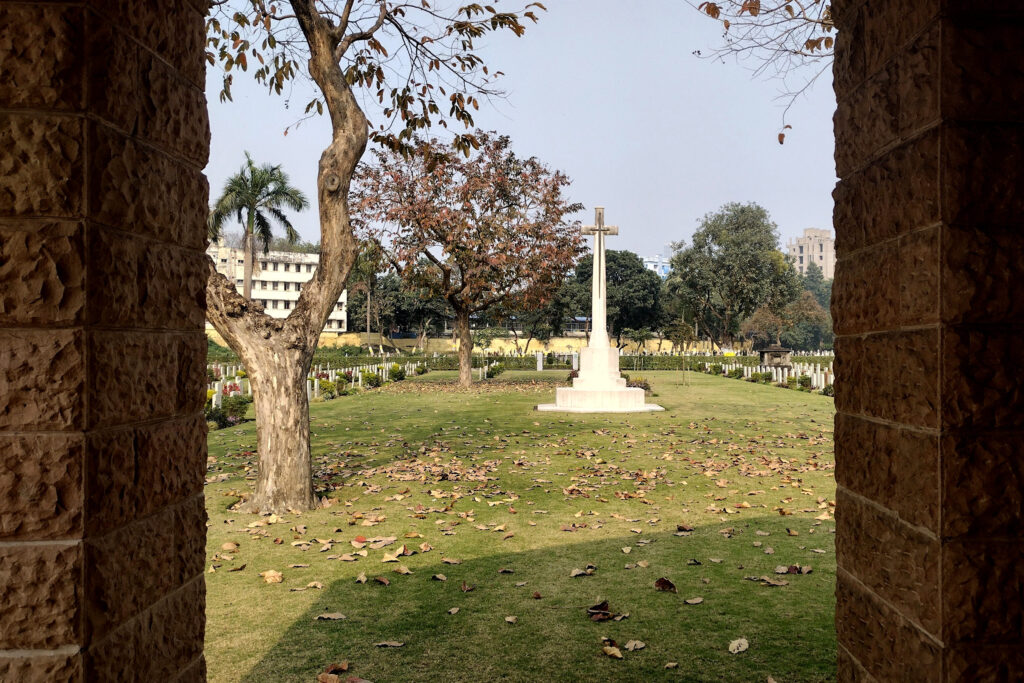
The Cross of Sacrifice and the Tennis Court

The inscription inside the shelter at the base of the Cross of Sacrifice reads:

HERE AROUND THE TENNIS COURT OF THE DEPUTY COMMISSIONER LIE MEN WHO FOUGHT IN THE BATTLE OF KOHIMA IN WHICH THEY AND THEIR COMRADES FINALLY HALTED THE INVASION OF INDIA BY THE FORCES OF JAPAN IN APRIL 1944

Buried here are 1,420 Commonwealth war dead, of whom 125 are unidentified. A further 917 Hindu and Sikh soldiers who were cremated in accordance with their faith are commemorated on the Kohima Cremation Memorial

The Cremation Memorial

The missing from the battles in the region are amongst those commemorated on the Rangoon Memorial.[3]

There are eight Royal Signals all ranks buried at Kohima, five of who were killed during the battle, and three who died in hospital in Kohima or elsewhere in the region at other times:

3603687 Signalman FRED HOUGHTON BOYD
2nd Divisional Signals
Killed in action on 12 June 1944 during the latter stages of the Battle of Kohima. Continue reading

Bhowanipore Cemetery, Kolkata

During a recent visit to India with ‘The Forgotten War Tour’ led by Dr. Robert Lyman MBE and organised by Bertie Alexander of Sampan Travel, I was able to visit the Commonwealth War Graves Commission cemeteries in Kolkata, Kohima in Nagaland and at Digboi in Assam. Here are the Royal Signals casualties that lie in the former, and at the end some interesting graves & stories. Thanks to Rabi Singh for the photos I missed. Thanks also to Nigel Sly for the information about Carpenter Leo John Galvin. 

The Cross of Sacrifice

Bhowanipore Cemetery in Kolkata lies one kilometre south of the Maidan and is accessed from Debendra Lal Khan Road. The Commonwealth War Graves Commission section is at the rear (western) part of the cemetery. In addition to war graves from the First and Second World Wars, it includes over 230 non-World War graves from the 19th and 20th centuries. The CWGC section was established in its present form in the 1950s when graves from other parts of the cemetery were concentrated. It is beautifully tended by the head gardener Rabi Singh.

Head Gardener, Rabi Singh

During the Second World War, No. 47 British General Hospital was in Kolkata from January 1943 to the beginning of February 1945; it was replaced by No. 21 British General Hospital in January 1945. Also established in Kolkata was No. 119 Indian General Hospital (Combined). All of the 15 Royal Signals (and one Indian Signal Corps) casualties died in those hospitals as a result of disease or natural causes, or as a result of accidents in the Kolkata area.

Royal Corps of Signals and Indian Signal Corps

6105402 Driver JOHN HERBERT BUTLER
No. 1 Special Communications Group Signals
Died on 10 March 1944 in British General Hospital, Calcutta
as a result of  injuries sustained in an accident. Continue reading

Commemorating Royal Signals War Dead – New Page, ‘K’

The Royal Signals casualties whose surnames begin with ‘K’ have now been included on the War Dead page on this website (the document opens as a pdf). The 118 casualties include 34 who were killed in action or died of wounds (the most recent being Sergeant B. R. Keen, 14th Signal Regiment (Electronic Warfare), who was killed in action in Afghanistan in 2007), and 23 men who died as prisoners of war in the Second World War. As is the case across all of these pages over 12.5% of fatal casualties occurred in road traffic accidents, a figure that increases in the modern era reflecting the advances in medical care that reduce the number dying of disease.

Brookwood 1939-1945 Memorial © CWGC
Commemorated on the memorial to the missing of the Second World war are:
Company Quartermaster Serjeant Albert Horace Kemp, 8th Anti-Aircraft Brigade Signal Section, killed with his family at Merstham near Reigate in a bombing raid on 19 April 1941; their remains were never found.
Captain Oliver Cecil Kisch, Air Formation Signals, killed in action and lost at sea on 17 June 1943 when the troopship SS Yoma was sunk on route from Tripoli to Alexandria.
Signalman Robert Wilson Kerr, who drowned in the Firth of Forth on 16 October 1946.