
This blog post originally appeared in 2020 on my website dealing with Royal Signals honours and awards. With the closure of that site I have updated it and moved it here.
I must firstly record my most sincere thanks to Muhammad Naeem, a civil engineer from Khyber Pakhtunkhwa, for his enthusiastic help in providing the photographs used here. For more information on the men buried at Manzai Fort cemetery, please read the notes linked to each of the photographs in the galleries.
One of the interests that I have developed while working on the Royal Signals honours and awards project relates to the fate of the Corps’ casualties, particularly those who lie in graves not maintained by the Commonwealth War Graves Commission. One of my keenest interests is in the casualties of the inter-war years, particularly those men who died in the North-West Frontier Province.[1]
Most of the military cemeteries and many of the civilian graveyards in which they lie are no longer in use and are not maintained. Although many have become derelict they remain a feature of the locale and some are protected by virtue of the fact that they sit within or near military or Frontier Constabulary bases.
In the account of the Shahur Tangi Ambush, which occurred a little over 85 years ago on 9 April 1937, I showed photographs of the graves of Corporal E. C. Turner and Signalman N. Davies who were killed in action. They were buried in the cemetery at Manzai Fort.

The graves of Corporal E. C. Turner and Signalman N. Davies
A British military outpost was first established at Manzai in 1919 during the Third Anglo-Afghan War and over the next two decades it grew into an important base in the region, served by a narrow-gauge railway and a small airstrip. Located at 1,600 feet on a 13-miles long ridge in the land of the Mahsud, Manzai Fort is a little over 60 miles from the ancient city of Dera Ismail Khan to the east, the headquarters of Waziristan District Signals through much of the 1920s and 1930s. Twenty-five miles by road to the east is Tank, the district capital and an important British base for operations into southern Waziristan. Twelve miles to the north-west is Jandola, another important post throughout the various Waziristan campaigns, which lies at the junction of the Shahur and Tank Zam rivers and the start of the two main routes into Mahsud tribal territory. Running along the ridge on which the fort sits is the Tank-Jandola road. Testament to the site’s importance it remains in use by the Frontier Constabulary. For much of its existence the fort had a small hospital, which accounts for the number of men who died here of illness and disease.
The cemetery is located on the east of the Tank-Jandola road, half a mile north of the fort.[2] Built on a shallow slope, the cemetery is surrounded by a stone wall with decorative corner posts. Some of the graves are covered with stone plinths and each grave has a cement-covered, stone marker inscribed with the details of the casualty. These cement-covered markers appear to be as a result of a refurbishment of the cemetery in the late-1930s, and this may explain some of the errors on them. The harsh weather in the region accounts for most of the damage but some stone blocks making up the plinths have been removed.

Fort Manzai Cemetery – view from the north-west corner
Royal Signals Burials at Manzai Fort
(Additional details may be found linked to the photographs in the gallery.)
-2309555 Lance Corporal Alfred John Cowderoy, ‘B’ Divisional Signals, died of disease or illness at Manzai Fort on 28 March 1923, aged 21.
-2324234 Signalman Norman Davies, Waziristan District Signals, killed in action on 9 April 1937 at Shahur Tangi, aged 22.[3]
-5239123 Sergeant Caleb William Muddiman, W/T Section, Manzai Detachment, Waziristan District Signals, died suddenly of disease or illness at Manzai on 2 April 1927, aged 36.
-2316052 Corporal Edward Cooper Turner, Waziristan District Signals, killed in action on 9 April 1937 at Shahur Tangi, aged 31.
Killed in Action on 9 April 1937 at Shahur Tangi & Buried at Manzai Fort
(Additional details may be found linked to the photographs in the gallery.)
-Major Henry William Dayrell Palmer, 3rd Battalion, 16th Punjab Regiment.
-Captain Myles Bertram Courtney, 3rd Battalion, 16th Punjab Regiment.
-Lieutenant Michael Earle, Royal Regiment of Artillery, 2nd (Derajat) Mountain Battery (Frontier Force).
-Lieutenant Edwin Stuart Rainier France, 3rd Battalion (Duke of Connaught’s Own), 7th Rajput Regiment.
-Lieutenant Eric Charles Langford Hinde, Corps of Royal Engineers, 19th Field Company, Royal Bombay Sappers and Miners.
-Second Lieutenant George Laurence Scott, 3rd Royal Battalion (Sikhs), 12th Frontier Force Regiment.
Other Burials at Manzai Fort
(This list should not be considered complete. Additional details may be found linked to the photographs in the gallery.)
-Captain Frederick Herbert Fardell MC, Royal Regiment of Artillery, 8th Lahore Mountain Battery, died of disease or illness on 21 September 1927.
-Flying Officer Kenneth Northcote Lees, No. 5 (Army Cooperation) Squadron, Royal Air Force, was killed in an air crash on 11 March 1937.
-Lieutenant Arthur Sidney Noel Barron, No. 14 Indian Motor Transport Company, Indian Army Service Corps, died of disease on 29 July 1922.
-1040 Company Quartermaster Sergeant C. W. Rowley, No. 8 Indian Motor Transport Company, Indian Army Service Corps died on 13 July 1922.
-787349 Staff Sergeant John Davies, Indian Army Service Corps, died on 22 July 1934.
-5878587 Staff Sergeant R. Weaver, The Northamptonshire Regiment attached to the Indian Army Service Corps, died on 16 December 1923.
-M/14716 Sergeant Alfred William Beer, No. 18 Indian Motor Transport Company, Indian Army Service Corps, died on 15 May 1926.
-M/14476 Sergeant Albert Edward Beavan, No. 24 Indian Motor Transport Company, Indian Army Service Corps, took his own life on 8 November 1923.
-1852132 Lance Sergeant Allan Urquhart Liddell, Corps of Royal Engineers, died on 15 July 1926.
-7870494 Private Douglas Alexander Hay, 9th Armoured Car Company, Royal Tank Corps, took his own life by way of a self-inflicted gunshot from a revolver on 25 April 1923.
-Private-Follower Joseph, 1st Madras Pioneers, died 2 December 1921.
Private D. Davidson, 2nd Battalion, The Argyll and Sutherland Highlanders (Princess Louise’s), was killed in action on 27 May 1937.
-2979103 Private Neil McCracken, 2nd Battalion, The Argyll and Sutherland Highlanders (Princess Louise’s), was killed in action on 27 May 1937.
-5242658 Private Ernest W. Mealin, The Worcestershire Regiment attached to Headquarters 10th Indian Infantry Brigade, died of disease or illness at Manzai on 21 June 1922.
-2979738 Private J. Moore, 2nd Battalion, The Argyll and Sutherland Highlanders (Princess Louise’s), was killed in action on 27 May 1937.
Manzai Fort Cemetery
-

- Fort Manzai Cemetery – Entrance
-
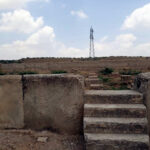
- Fort Manzai Cemetery – Entrance
-

- Fort Manzai Cemetery – view from the north-west corner
-
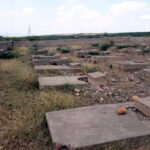
- Fort Manzai Cemetery – view from the south-west corner
-

- Fort Manzai Cemetery
-

- Fort Manzai Cemetery
Royal Signals Graves at Manzai Fort
-

- Lance Corporal Alfred John Cowderoy
-

- Signalman Norman Davies
-

- Lance Sergeant Caleb William Muddiman
-

- Corporal Edward Cooper Turner
9 April 1937 Shahur Tangi Casualties Buried at Manzai Fort
-
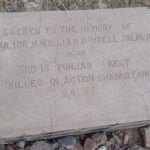
- Major Henry William Dayrell Palmer
-

- Captain Myles Bertram Courtney
-

- Captain M. B. Courtney and his bride, Miss Penelope Curtois Lakes Howard
-

- Memorial to Major H. W. D. Palmer and Captain M. B. Courtney at the Holy Trinity Cathedral Church, Sialkot
-

- Lieutenant Michael Earle
-

- Lieutenant Edwin Stuart Rainier France
-

- Lieutenant Eric Charles Langford Hinde
-

- Second Lieutenant George Lawrence Scott
Other Burials at Manzai Fort
-

- Captain Frederick Herbert Fardell MC
-
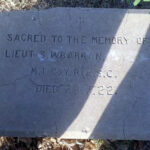
- Lieutenant Arthur Sidney Noel Barron
-

- Flying Officer Kenneth Northcote Lees
-

- Staff Sergeant John Davies
-

- Company Quartermaster Sergeant C. W. Rowley
-
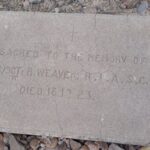
- Staff Sergeant R. Weaver
-

- Sergeant Albert Edward Beavan
-

- Sergeant Alfred William Beer
-
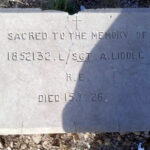
- Lance Sergeant Allan Urquhart Liddell
-

- Private Douglas Alexander Hay
-

- Private-Follower Joseph
-
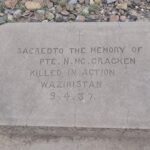
- Private Neil McCracken
-

- Private Ernest W. A. Mealin
-

- Private J. Moore
-

- The Argyll and Sutherland Highlanders (Princess Louise’s) Memorial
1. (Back) Now Khyber Pakhtunkhwa, Pakistan, which since 2018 has included the Federally Administered Tribal Areas.
2. (Back) Manzai Fort coordinates: 32.249555, 70.246004. Cemetery coordinates 32.261531, 70.243371.
3. (Back) Incorrectly recorded on the Royal Signals Roll of Honour as ‘Signalman C. Davis’.
During my professional career as a journalist for the Statesman daily Peshawar in 2004, I had also covered the related stories about the historic aspects of Manzai fort and the British cemetery. Another one was located in front of Kaur Fort near Tank city where several graves of British army officers KIA during Waziristan operations during 1921 to 1937 were located. Lost record of all photographs of the same cemetery.
Hi Nick.
Thank you for your informative webpage. Eric Hinde was my father’s best friend at school. He was only in NW province as a punishment. He had fallen in love with Barbara Skelton and in the process of bidding farewell when she sailed from Bombay, he had inadvertently sailed with her. He was arrested by military police at the first port of call and returned to India. The rest you know. Barbara Skelton was later the mistress of Cyril Connolly. She herself wrote and was published. All this detailed in D J Taylor’s recent book, The Lost Girls.
Rob Tresidder
Hello Rob,
Thank you for the note adding some colour to Hinde’s tale. An extraordinary story indeed. After a bit of digging I believe that his departure from India wasn’t inadvertent; he was evidently smitten with Barbara Skelton and, it seems, not particularly interested in a military life. Apparently, he had been quite ill before this escapade, which he used as mitigating circumstances at his subsequent disciplinary hearing. I have added some detail to the information with the photo of his grave.
Nick
Thank you for taking the time to remember these men. It is clear from your photos that their stone memorials will not last much longer 🙁
You may be right. For most of these cemeteries it is the ravages of time that is the enemy rather than vandalism so I suspect they’ll be there for some time yet but it is sure to turn into an archaeological site.
Nick
Almost every month, I pass through this place and feel saddened for those great officers who traveled so far and fought bravely. However, it seems that today, your country has forgotten them.
Hello Nick Metcalfe,
I hope this message finds you well. My name is Hussain Mehsud, and I am the great-grandson of the esteemed Khonia Khel Jalal Khel, who fought in the Battle of Shahur Tangi against the British Army. As you may know, photography was not widely available at that time, and unfortunately, we do not have any pictures of him or that historical period.
I would be extremely grateful if you have any historical photographs from that time, particularly any that may include my great-grandfather. Additionally, if you have any relevant details or records, I would greatly appreciate it if you could share them with me.
In 2000, our family had the honor of hosting British visitors in Chagmalai, South Waziristan, near Jandola—where Shahur Tangi is located. These visitors were descendants of British Army officers who lost their lives in the Battle of Shahur Tangi.
Thank you for your time and consideration. I look forward to your response.
Best regards,
Hussain Mehsud
Hello Hussain Mehsud,
Thank you for getting in touch. I will reply by email.
Nick
Hello Hussain Khan,
I am reading the account of the Shahur Tangi ambush of 1937 and as it mentions your great grandfather, I was interested in this character a little bit more. That brought me here to this page. It is great to find that one of his descendants is here and interested in the story of his forebears.
Alan Warren book on Waziristan is one great source to read about Waziristan in the colonial era especially from 1894 onwards i.e the stories of Mullah Powindah and Faqir of Ipi and off course your great grandfather Khonial Khel Jalal Khel Mahsud.
Would love to hear from you and probably meet you one day. And discuss all that preceded us. In our land. Waziristan.