Category Archives: First World War

‘Class ‘B’ Mentions’—Rewards for Valuable Services Published in The Times during the First World War

(This is an updated version of a previous post from 2019.) Some time ago as I was working through one of the registers in my Royal Signals honours and awards project, I came across an anomaly. The obituary in The Wire for Major General A. C. Fuller C.B.E.—the inventor of the Fullerphone—records that he was mentioned in despatches four times and that he did not receive the Victory Medal. These statements are at odds—if he did not serve in a theatre of war he could not have been mentioned in despatches. There are some exceptions to that statement, but Experimental Officers at the Signals Experimental Establishment were not amongst them. A little more digging revealed that these were ‘class ‘B’ mentions’ for ‘valuable services in connection with the war’. I was unable to track them down easily, however, and this post is the result of my research into where such awards may be found.

An extract from War Office List of 23 August 1919 showing Scottish officers. (The Courier, 23 August 1919.)

Meritorious service by military personnel and civilians at home was recognised largely only in the latter years of the war, primarily by the various grades of the Order of the British Empire, created in June 1917. In addition, a lower category of commendation, broadly the equivalent of a mention in despatches, was awarded to those who were brought to notice for ‘valuable services’. They are often referred to as ‘class ‘B’ mentions’. Most were for service in the United Kingdom, but some awards were made for service in the Dominions and Colonies. They were usually awarded in the name of the Secretary of State for War but several were attributed to the Home Secretary.[1]

Although the War Office, Air Ministry and Home Office lists, or communiqués, were described as supplements to the London Gazette, they did not appear in the Gazette but were instead provided to the press for publication. Extracts may be found in regional newspapers, often highlighting the work of local recipients with short citations, but The Times became seen as the ‘official’ avenue of publication because it featured the full lists. The first War Office communiqué appeared in February 1917 and the last in June 1920. Similar lists were announced by the Admiralty, although they do not appear to have been published by The Times in the same way.[2]

Several lists were not published in The Times. Inexplicably, the list of 23 August 1919—Army officers and other ranks rewarded for service in departments of the War Office—was published in full only in The Daily Telegraph, and the accompanying (very large) list of 28 August—for service in the commands and districts of Home Forces—was only published in part; again it was published in full in The Daily Telegraph. Of the five communiqués in 1920, only two were published in full. Three lists, amounting to around 2,200 names, were announced in The Times in a short paragraph but without any accompanying names. It appears that the press quickly lost interest in these rewards for service because those in the final list do not even appear in regional newspapers. Continue reading

Lieutenant Luigi Parisotti, 4/39th Garhwal Rifles

As a researcher of military history, one of my greatest sources of satisfaction is the acceptance by the Commonwealth War Graves Commission of a correction to a record of commemoration. Mostly as a consequence of the digitisation process, such errors are legion. Additionally some casualties were missed for various reasons. My first success was the inclusion of one of Blacker’s Boys, the 9th Royal Irish Fusiliers, on the Addenda Panel at Thiepval; he was killed on 1 July 1916 but his death had not been recorded. For some years I have been examining the CWGC commemorations from the First World War in the United States and recently I have been working on a project to ensure the correct commemoration for all Royal Signals casualties. My latest success, however, was for an infantry officer killed in action in Waziristan whose date of death and regiment were recorded incorrectly; he was killed in a fight that earned another officer a posthumous Victoria Cross.

Lieutenant Luigi Maria Parisotti was born on 25 July 1891 in Paddington, London, the son of an Italian father and an English mother; he was the fourth of five children.[1] He was educated at Stonyhurst College; Collège Saint Pierre, Calais; and the Sorbonne.[2] At some time he began to use the name ‘Louis’.

Luigi Parisotti

Parisotti was commissioned into Alexandra, Princess of Wales’s Own (Yorkshire Regiment) on 2 September 1915. After a period with the 3rd (Reserve) Battalion at West Hartlepool, he joined the 2nd Battalion of the Green Howards near Carnoy in France as a platoon commander in ‘D’ Company in February 1916. The battalion was part of 21st Brigade in 30th Division, which had transferred from 7th Division the previous December and on doing so lost two of its regular battalions to other brigades in 30th Division, receiving two ‘Pals’ battalion in their place—18th (Service) Battalion, King’s (Liverpool Regiment) (2nd City) and 19th (Service) Battalion, Manchester Regiment (4th City). Continue reading

Non-Commissioned Officers and the Military Cross

This blog post originally appeared in 2016 on my website dealing with Royal Signals honours and awards. With the closure of that site I have updated it and moved it here. 

The medals of Lance Sergeant D. E. Ward M.C.

After the 1993 review of decorations and medals for gallantry, the Military Cross replaced the Military Medal as the third level award for non-commissioned officers and other ranks. Prior to 1993 there were 98 Military Crosses, including two bars, awarded to officers of the Corps, one award to a warrant officer during the Second World War and one to a warrant officer during the Borneo Confrontation. In addition, there were several awards to officers of the Indian Signal Corps serving alongside their Royal Signals counterparts in actions in North Africa, the Italian Campaign and Burma. Since 1993 there has been only one Military Cross awarded to a Royal Signals non-commissioned officer—to Sergeant N. J. Hillyard in 2016.[1] He is not, however, the first N.C.O. of the Corps to wear the ribbon of the Military Cross.

In India on the evening of Saturday 1 February 1936, two N.C.O.s of Kohat District Signals were returning to camp in a motor-cycle and sidecar along a mist-covered road east of the town when they hit a bullock cart—one was killed and the other badly injured.[2] The dead man was Lance Sergeant D. E. Ward M.C., an attached N.C.O. from ‘A’ Corps Signals.[3]

Kohat District Signals (Lance Sergeant D. E. Ward M.C. is on the left)

Continue reading

Major Robert Norman Dodds MBE, MC, DCM, MM

This blog post originally appeared on my site dealing with Honours and Awards to Royal Signals. It is reposted here in anticipation of that site’s closure.

Second Lieutenant R. N. Dodds MC, DCM, MM, Russia, 1920

One hundred and two years ago, on 22 May 1920 the former Royal Navy hospital ship and troop transport SS Dongola arrived in England carrying some of the last British and French refugees to flee Bolshevik Russia. Amongst the passengers was also the final batch of British prisoners of war, who had been captured a year before during the operations in North Russia. One of their number was Second Lieutenant Robert Dodds MC, DCM, MM of the Royal Engineers Signal Service.

Dodds was commissioned into Royal Signals just prior to the Second World War and was made an MBE for his service in North Africa. I came across him while researching something completely different a few years ago and intrigued by his multiple decorations—he was one of only two men to receive this combination of awards[1]—I saved on my computer the London Gazette that recorded his retirement, meaning to return to it later. It became one of the catalysts that promoted my wider study of Royal Signals gallantry awards.

He is an excellent example of a significant number of decorated soldiers whose gallantry awards are, by necessity, consigned to a brief mention in the Register of Awards. It was an aspiration to record the awards made to those who earned them prior to joining Royal Signals but that has proven to be an impossible task to complete accurately. Nonetheless, the full story of Dodds’ repeated gallantry is worth recounting. Continue reading

The Dedication of the Ulster Battlefield Memorial Tower, 19 November 1921

My great-grandfather, Sergeant William Neill DCM, served with 9th Royal Irish Fusiliers—Blacker’s Boys—during the First World War. One hundred years ago he returned to the Somme, to Thiepval, for the dedication of the Ulster Battlefield Memorial Tower. This is an account of the events and includes a gallery of the memorabilia that he kept. It also includes a scene-by-scene description of the news clip filmed for Pathé News, in which he appears at the very end.

Ulster Tower

The Ulster Battlefield Memorial Tower was proposed in November 1919 by Sir James Craig MP. Based on Helen’s Tower at Clandeboye in County Down, it was designed by Bowden and Abbott Ltd of London[1] and built quickly by Fenning & Co Ltd, specialists in granite memorials, and the Société de Construction et Travaux Publics d’Arras. (See the plans here.) The land had been purchased from three families that farmed the area around Thiepval. The Ulster Tower, as it has become known, was the first official memorial raised on the Western Front—it was opened and dedicated on Saturday 19 November 1921. The tower is owned by the Somme Association and you can read more about its centenary here.

Continue reading

March 1918 – Sergeant James Hughes DCM, MM

The medals of Sergeant James Hughes DCM, MM

In March 1918, for the third time in 21 months, the 9th Royal Irish Fusiliers in 108th Brigade, 36th (Ulster) Division was all but destroyed. Blacker’s Boys devotes a whole chapter to the actions fought in the week following the German attack south of the River Somme and the subsequent action against the German second phase attack south of Ypres.

In these actions, 36th (Ulster) Division suffered over 7,200 casualties, of which over 5,600 were missing, most of whom had been captured. This was the highest casualty rate of any division facing the German attack. The 9th Royal Irish Fusiliers lost 46 killed or died of wounds, 142 wounded and an estimated 334 captured. By this stage of the war the Battalion was nothing like that which had landed in France in October 1915. The majority of its men were those who had joined from 2nd North Irish Horse, there was also a fair number of Englishmen—from Yorkshire, Derbyshire and London—and Irish soldiers from all over Ireland, both Catholic and Protestant.

Many of the men killed in the actions fought in March 1918 were later described as falling in the period 21-29 March or on 29 March but neither of these descriptions is wholly accurate. Continue reading

21 March 1918 – Racecourse Redoubt

One hundred years ago, on 21 March 1918 on the first day of the German offensive that swept back the British Fifth Army, my great-uncle Robbie was captured in the ‘Line of Resistance’ at the very front of the defensive positions held by 15th Royal Irish Rifles in 107th Brigade in 36th (Ulster) Division. His story is here.

107th Brigade Forward Zone

Twice they got out on top and walked along it, clearing enemy out of it with rifle and rifle grenades.’

Farther back, ‘D’ Company held out in Racecourse Redoubt until that evening. During the attacks there in the morning, one of ‘D’ Company’s platoon commanders, Second Lieutenant Edmund De Wind, defended his position most gallantly and, assisted by Corporal Samuel Getgood and Lance Corporal Hubert Walker MM, repeatedly cleared the enemy from a trench at the west of the redoubt. Around midday De Wind was killed; Getgood and Walker were captured when the redoubt was surrendered that evening. For their gallantry De Wind was posthumously awarded the Victoria Cross and Getgood and Walker were awarded the Distinguished Conduct Medal.

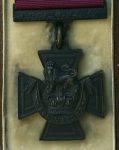
Recently I was able to help a descendent of De Wind put together some of his story, in preparation for a commemorative event in Comber, Northern Ireland, De Wind’s home town prior to his emigration to Canada. It is with his permission that I can show these fabulous photographs of his Victoria Cross. In 2019 Josh De Wind completed a fuller account of his great-uncle’s life—A Crown of Life—which you can read here.[1]


1. (Back) De Wind, J. (2019). A Crown of Life—Edmund De Wind, VC. Self Published.

The Boche had beaten us, and the slaughter terrific.

The graves of Lieutenant Colonel S J Somerville, the Commanding Officer, and Captain R D Miles, C Company, Brandhoek New Military Cemetery No. 3

Few of the 154 officers and men of the 9th Royal Irish Fusiliers who were killed immediatley prior to or during the attack on 16 August 1917 lie in marked graves—three-quarters are commemorated on the Tyne Cot Memorial, a substantially higher proportion that those killed on 1 July 1916 who are commemorated on the Thiepval Memorial. There are four primary reasons for this: firstly, very few bodies could be recovered immediately after the action from the area over which the Battalion had attacked; secondly, the area was subjected to continued severe shelling and was not captured until over a month later, by which time many of the bodies were destroyed; thirdly, in early 1918 a narrow gauge railway was built over the area from which the attack was launched, and, fourthly—in consequence—few of the bodies were identified by name in the post-war battlefield clearance.

When the heavy rain began on 31 July 1917, the men of the 9th Royal Irish Fusiliers were at Watou, seven miles west of Ypres preparing for the forthcoming offensive. On 2 August, the Battalion was ordered forward with 13th Royal Irish Rifles and two battalions from 109th Brigade to take over a reserve position in the trenches from which 55th (West Lancashire) Division had attacked on the first day of the battle. This period in the line was short but exhausting, spent in muddy, partially destroyed and crowded trenches and, in the last few hours as the men began the move back west of Ypres, under gas attack. Miraculously, casualties were few but two men, James Greer from Rathfriland and Isaac Hague from Nottingham, would die of their injuries some days later.[1]

Continue reading

Certificates for Gallantry Awarded by 10th (Irish), 16th (Irish) and 36th (Ulster) Divisions

I have always been interested in the gallantry certificates of the three divisions raised in Ireland, about which there is very little information in a single source. I would be very grateful for contributions that support or contradict my comments.

In addition to the array of British and foreign decorations and medals awarded for gallantry during the First World War, many British Army divisions awarded certificates that recognised brave conduct brought to the notice of the divisional commander.

The certificates were produced in various formats and were of varying quality—some were of simple design and printed locally, others were more ornate and printed in the United Kingdom. The numbers awarded are impossible to determine. Many were instituted before the Military Medal came into being in March 1916 and, as the Military Medal became widely and more frequently awarded, these certificates became less common. Nonetheless, they continued to be awarded, in some divisions, and in various formats, throughout the war and they often preceded the award of a gallantry medal or decoration for the same act. Details of awards may be found in unit and formation war diaries and in local newspapers but these records are inconsistent.

All three of the divisions raised in Ireland produced such certificates (see the photo gallery for examples and dimensions). Continue reading

Sacrifice – New Biographies Published

The Canadian Book of Remembrance showing the entry for Private Lawrence Manning

Three new biographies have been added to the Sacrifice project website:

Private Chester Covell Buck served briefly in England with 202nd (Sportsman’s) Battalion before being sent back to Canada unfit for further duty. He died in Ponoka Asylum Hospital, Alberta, on 7 December 1917 and was buried in Oak Hill Cemetery, Plymouth, Indiana.

Private Lawrence Eugene Manning served in France with 72nd Canadian Infantry Battalion (Seaforth Highlanders of Canada). Greatly affected by his experiences, he took his own life on 9 November 1919 and is buried in Salt Lake City Cemetery, Salt Lake City, Utah.

Second Lieutenant George Albert Ruffridge and Cadet Hugh Barker O’Leary of No. 80 Canadian Training Squadron were killed in a flying accident at Camp Bordon in Canada on 6 May 1918. Ruffridge was buried in Rosedale Cemetery, Montclair, New Jersey.