

9th (Service) Battalion, Princess Victoria’s (Royal Irish Fusiliers) (County Armagh)
9th (North Irish Horse) Battalion, Princess Victoria’s (Royal Irish Fusiliers)
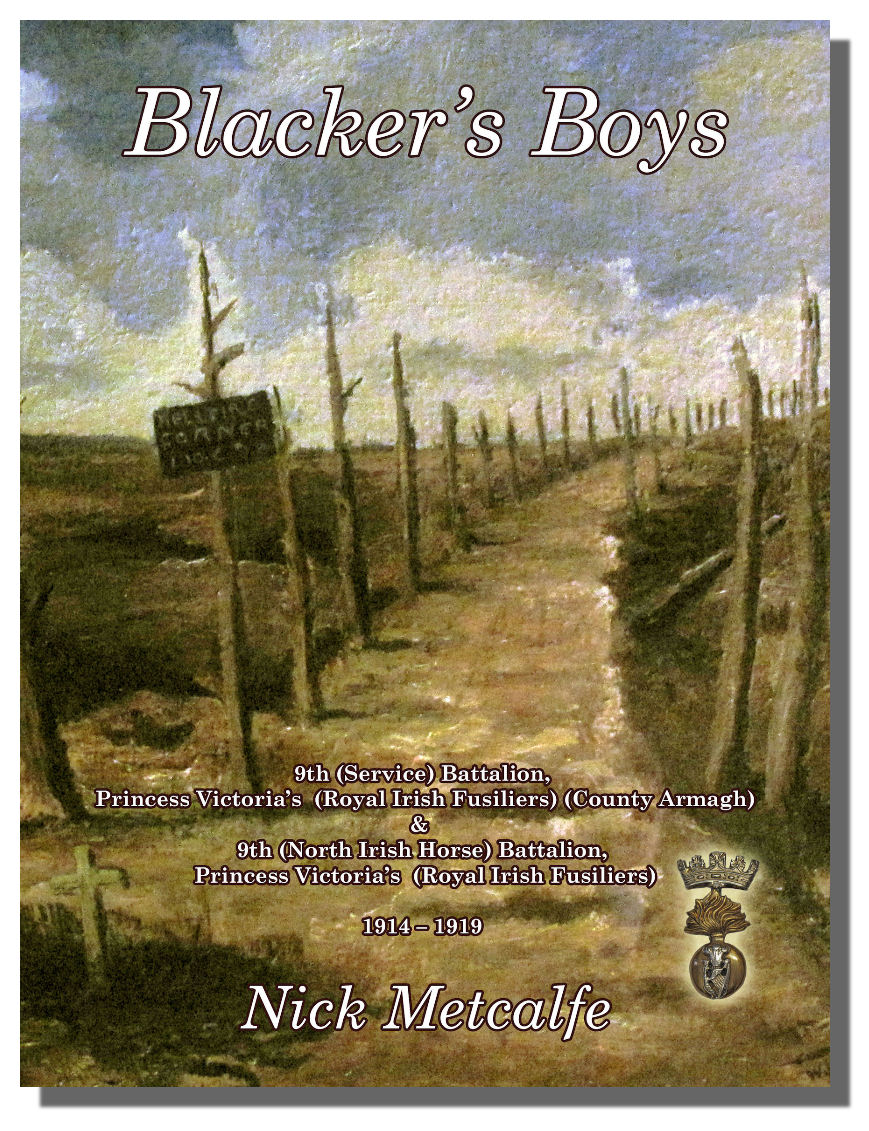 Blacker’s Boys tells the story of one of the finest infantry battalions raised in Ireland during the First World War, from its birth in September 1914 to its demise in June 1919.
The formation of 36th (Ulster) Division was steeped in the politics surrounding the long-running Home Rule crisis in the early years of the 20th Century. In 1912 the Third Home Rule Bill proposed granting self-government to Ireland. As a direct consequence, in the northern counties of Ireland the Ulster Volunteer Force was formed to resist the imposition of the Act. On the outbreak of war in 1914 the implementation of Home Rule was suspended and the Ulster Volunteers provided the basis for the recruitment of 36th (Ulster) Division.
The 9th (Service) Battalion, Princess Victoria’s (Royal Irish Fusiliers) (County Armagh) was one of thirteen infantry battalions raised for 36th (Ulster) Division. It was made up largely of men of the Ulster Volunteers from the north of County Armagh and commanded by Lieutenant Colonel S W W Blacker, a scion of the Ulster Unionist movement.
Amalgamated with the 2nd North Irish Horse in September 1917, it became the 9th (North Irish Horse) Battalion, Princess Victoria’s (Royal Irish Fusiliers). By the time the war ended it was a mix of Protestant and Roman Catholic Irishmen, Englishmen from Yorkshire, Nottinghamshire and London, regular soldiers, war-time volunteers and conscripts.
‘This is the voice of reality, impeccably researched.’
From the foreword by Lieutenant General Sir Philip Trousdell KBE, CB
‘I cannot praise this work enough, it must form a great example for others to follow.’
Bob Wyatt – Stand To! The Journal of the Western Front Association. No. 97. May 2013
Blacker’s Boys – Update and Additional Material
Since Blacker’s Boys was published in November 2012, I have received much additional information and photographs about the battalion and the men who served in its ranks. All of this has been compiled into a free-to-view and download Addendum volume in the same format as the book. In addition, the letters of the battalion’s commanding officer, Lieutenant Colonel Stewart Blacker, were published daily 100 years after they were first written. Blacker’s Letters ran from October 2015 to March 2017 and the final collection of letters remains on-line. Finally, there are two other items that may be of interest to those with relatives who served with the regiment—a series of essays about the evolution of each battalion in the war, i.e. an explanation of its make-up at war’s end, and a study of the gallantry certificates awarded to the three divisions raised in Ireland; links to those pages may be found here.
Buy Blacker’s Boys (ISBN: 978-0957269507)