Category Archives: Royal Signals Honours & Awards

‘Class ‘B’ Mentions’—Rewards for Valuable Services Published in The Times during the First World War

(This is an updated version of a previous post from 2019.) Some time ago as I was working through one of the registers in my Royal Signals honours and awards project, I came across an anomaly. The obituary in The Wire for Major General A. C. Fuller C.B.E.—the inventor of the Fullerphone—records that he was mentioned in despatches four times and that he did not receive the Victory Medal. These statements are at odds—if he did not serve in a theatre of war he could not have been mentioned in despatches. There are some exceptions to that statement, but Experimental Officers at the Signals Experimental Establishment were not amongst them. A little more digging revealed that these were ‘class ‘B’ mentions’ for ‘valuable services in connection with the war’. I was unable to track them down easily, however, and this post is the result of my research into where such awards may be found.

An extract from War Office List of 23 August 1919 showing Scottish officers. (The Courier, 23 August 1919.)

Meritorious service by military personnel and civilians at home was recognised largely only in the latter years of the war, primarily by the various grades of the Order of the British Empire, created in June 1917. In addition, a lower category of commendation, broadly the equivalent of a mention in despatches, was awarded to those who were brought to notice for ‘valuable services’. They are often referred to as ‘class ‘B’ mentions’. Most were for service in the United Kingdom, but some awards were made for service in the Dominions and Colonies. They were usually awarded in the name of the Secretary of State for War but several were attributed to the Home Secretary.[1]

Although the War Office, Air Ministry and Home Office lists, or communiqués, were described as supplements to the London Gazette, they did not appear in the Gazette but were instead provided to the press for publication. Extracts may be found in regional newspapers, often highlighting the work of local recipients with short citations, but The Times became seen as the ‘official’ avenue of publication because it featured the full lists. The first War Office communiqué appeared in February 1917 and the last in June 1920. Similar lists were announced by the Admiralty, although they do not appear to have been published by The Times in the same way.[2]

Several lists were not published in The Times. Inexplicably, the list of 23 August 1919—Army officers and other ranks rewarded for service in departments of the War Office—was published in full only in The Daily Telegraph, and the accompanying (very large) list of 28 August—for service in the commands and districts of Home Forces—was only published in part; again it was published in full in The Daily Telegraph. Of the five communiqués in 1920, only two were published in full. Three lists, amounting to around 2,200 names, were announced in The Times in a short paragraph but without any accompanying names. It appears that the press quickly lost interest in these rewards for service because those in the final list do not even appear in regional newspapers. Continue reading

Honours, Decorations, and Medals to The Royal Corps of Signals

Following the announcement of the New Year Honours list, I have updated the Addendum to Honours, Decorations, and Medals to The Royal Corps of Signals. It includes the awards announced at the end of last year and also some new information. Most of the new information comprises the identification of units of men mentioned in despatches that has been gleaned from war diaries found in the Indian National Archives – Abhilekh Patal. This is an extraordinary treasure trove of information but the website is clunky and needs patience,

The pdf is available to download midway down this page.

Operation Varsity, The Rhine Crossing—
Royal Signals & United States 17th Airborne Division

(Update March 2025: This article has been updated to include more information about the fate of the various crew members and passengers and to add more photographs, including that of Signalman Teddy Beddington, which was provided by his nephew.)

(Update June 2026. This article has been rewritten to reformat it and to include additional detail. It can be read in the summer 2026 edition of The Journal published by the Royal Signal institution.)

1st Lieutenant Arnold L. Holt

Operation Varsity was the airborne component of the Rhine crossing (Operation Plunder) conducted by United States XVIII Corps (Airborne) that sought to capture the Diersfordter Wald between Hamminkeln and Wessel and seize crossings over the River Issel. On 24 March 1945, the British 6th Airborne Division landed by parachute and by glider at drop zones and landing zones at Hamminkeln in the north of the area and the United States 17th Airborne Division landed in the south, north of Wessel. A query posed to me by the grandson of Lieutenant Arnold L. Holt, 61st Troop Carrier Squadron, United States Army Air Forces created a route to a treasure trove of information from various sources that allows a more complete story to be told of the fate of the men of the Royal Corps of Signals serving with 17th Airborne Division.

Detachments of Royal Signals soldiers from 1st Airborne Corps Signals attached to No. 2 Air Support Signal Unit were landed by glider to support both divisions.[1] The use of British signallers by 17th Airborne Division was necessitated by the use of the British Second Tactical Air Force[2] for close air support. The No. 2 A.S.S.U. ‘tentacles’ (radio detachments) provided links from both divisions to Headquarters Second Army and to the Group Control Centres of Second Tactical Air Force for tasking. Separately, No. 2 A.S.S.U. provided a radio detachment at Headquarters XVIII Corps at Xanten. Continue reading

Honours, Decorations, and Medals to The Royal Corps of Signals

Following the announcement of the Birthday Honours list, I have updated the Addendum to Honours, Decorations, and Medals to The Royal Corps of Signals. It includes the awards announced last week and also some new information; in this iteration, more detail on the awards to Company Sergeant Major Grey and Signalman Whitmore, who accompanied the first team into Italian occupied Ethiopia in August 1940. Update, 11 July 2023: The Addendum also includes the Royal Signals Institution Awards for 2023.

The pdf is available to download midway down this page.

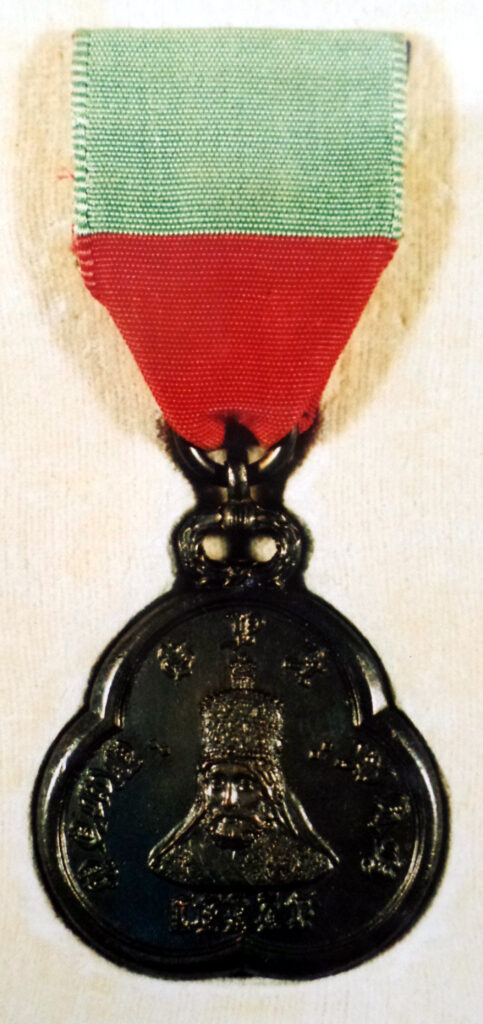
Military Medal of Haile Selassie I awarded to Warrant Officer Class I T. W. Whitmore

HMS Bulolo—No. 1 Ship Signal Section, 1942-1945 (Part 2)

Part 1 of this tale covered the period from the formation of No. 1 Ship Signal Section in 1942 until the arrival of HMA Bulolo in Bombay (Mumbai) in September 1943.

HMS Bulolo

HMS Bulolo’s deployment to the Far East in the latter part of 1943 was in preparation for amphibious operations in the late spring of 1944 against Japanese-occupied Sumatra and Malaya (Operation Culverin) and against the Andaman Islands (Operation Buccaneer). The plans were ultimately abandoned but not before No. 1 Ship Signal Section had spent time passing on its experience to new signal sections of the newly-formed 218 Signal Assault Wing.[1] In October, Bulolo took part in a command post exercise with the staff of 33rd Indian Corps (Exercise Otter) that simulated a divisional landing, with the staff from 36th Indian Division and 29th Infantry Brigade on board HMS Keren—the former being described as, ‘completely satisfactory’ but the latter (i.e. embarked division and brigade headquarters) as, ‘a complete failure’.[2] A similar event (Exercise Swordfish) was conducted with 2nd Division the following month, by which time the lessons had been learned and communications were much improved. A third exercise was cancelled in mid-December and Bulolo was ordered back to the Mediterranean. After spending Christmas at Bombay, she sailed for Italy via the Suez Canal.

Bulolo arrived at Naples on 12 January 1944 and immediately embarked Lieutenant Colonel L. T. Shawcross, commanding officer of 1st Divisional Signals. The division had been allocated to United States VI Corps as one of the two assaulting division for Operation Shingle—an amphibious landing at Anzio. The divisional staff and additional signallers embarked over the following days and on 18 January an exercise was carried out in the Salerno area. On 20 January, an interoperability exercise took place with the headquarters ship USS Biscayne, the flagship for the operation, and the following day the assault force sailed for Anzio.[3] The landings were largely unopposed and, from the perspective of the signal section, somewhat routine. The divisional staff disembarked on 23 January and the following day, in the midst of an air attack, Bulolo sailed for Naples and thence to Malta. March 1944 was spent in Algiers and on 7 April the ship’s company prepared to depart the Mediterranean. Prior to sailing a signal was received from Commander-in-Chief Mediterranean that read: ‘Whilst on Mediterranean Station you have played a very active part in operations and may be justly proud of your share in our successes. Goodbye and good luck to you and your ship’s company’. Continue reading

HMS Bulolo—No. 1 Ship Signal Section, 1942-1945 (Part 1)

In the Summer 2019 edition of the Journal of the Royal Signals Institution, John Young wrote an excellent short history of 661 Signal Troop (LPD). I was prompted to write something about the troop’s predecessor and where it all began—No. 1 Ship Signal Section on HMS Bulolo during the Second World War. The article (somewhat bizarrely attributed to Captain Neil Donaghy, who in fact wrote the update about Project Caduceus) was published in the Journal but (due to another editing error) that version was incomplete and missing its footnotes and some illustrations. The story is told here in two parts…

No. 1 Ship Signal Section was formed aboard HMS Bulolo at Chatham on 16 June 1942.[1] Arising out of the growing understanding of the requirements for effective command of amphibious landings, most importantly the need for a combined[2] headquarters afloat (a lesson learned on Operation Menace—the ill-fated attack on Dakar in 1940), HMS Bulolo was the first of several ships to be converted into a Landing Ship, Headquarters.[3] Designed as a passenger, general cargo and mail steamer, the 6,500-ton ship had piled her trade in the south Pacific for less than a year before war broke out in Europe. Bulolo was requisitioned in September 1939 and converted into an armed merchant cruiser, in which guise she worked as a convoy escort in the Atlantic until being bought by the Admiralty in March 1942.

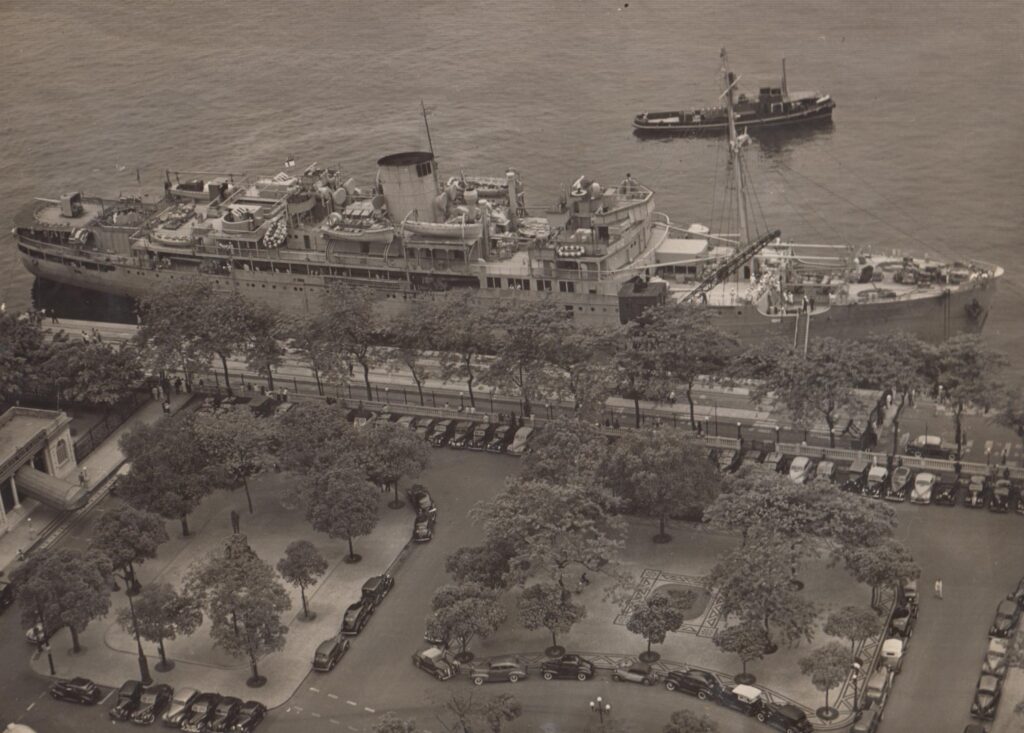
HMS Bulolo alongside in Rio de Janeiro on 24 November 1941. The placement of her original fit of seven 6-inch guns can be clearly seen—two forward below the bridge, two either side under the upper decks and one aft. The two 3-inch anti-aircraft guns can be seen towards the rear of the upper deck. This weapon fit was changed significantly when Bulolo became a headquarters ship. Compare with the photograph in Part 2 of the damage suffered in June 1944.

There then followed an extensive period of refitting—the forward cargo hold being converted into a three-deck suite of headquarters staff spaces and communications centres—which was completed that summer and by which time the conversion of a second ship, HMS Largs, had begun.[4] For most of this period, and for the period described here, HMS Bulolo was commanded by Captain R. L. Hamer DSO, the father of Lieutenant Colonel J. R. Hamer, Royal Signals.[5]

Continue reading

Sergeant Henry James ‘Harry’ May, 2nd Divisional Signals, Burma

The Mention in Despatches is arguably the United Kingdom’s oldest form of recognition for gallantry or meritorious service on operations. The inclusion of the names of those worthy of being brought to the attention of the Admiralty or War Office became well-established in the 19th Century. An excellent, early example is the ‘mention’ of Serjeant Moore of His Majesty’s 86th Regiment of Foot for his leadership of a forlorn hope in the assault at Bharuch on 29 August 1803 during the Second Anglo-Maratha War, which appeared in the London Gazette in April 1804.[1]

Unfortunately, in the modern era these awards are the most difficult to research. Even with information from a recipient’s family, service records and unit war diaries, the reason for the majority of mentions is impossible to determine.

During my research into Royal Signals honours and awards (there have been around 6,200 Mentions in Despatches to personnel of the Corps), I was contacted by the family of a Royal Signals sergeant who was mentioned for his conduct during the Burma campaign in the Second World War. Notwithstanding the wealth of information about him, we have been unable to track down any details of his award but his story is worth telling.

Corporal Henry James ‘Harry’ May before sailing for India

Harry May was born in Glasgow on 22 August 1913. He worked as a clerk and he was a pre-war Territorial Army solder. He had enlisted on 20 April 1939, just after the announcement that the Territorial Amy would be doubled in size, and joined 52nd (Lowland) Divisional Signals. He attended summer camp just prior to the outbreak of war, and was mobilised on 2 September and posted to the newly reformed 15th (Scottish) Division. By trade he was an ‘operator wireless and line’, an ‘OWL’. In April 1940, he was promoted to lance corporal and a bit over a month later to corporal. In June he was posted to No. 1 Company, 2nd Divisional Signals; it was with this unit that he would see out the rest of the war. Continue reading

The Hong Kong Signal Company and the SS Lisbon Maru

This blog post originally appeared on my website dealing with Royal Signals honours and awards. With the closure of that site I have updated it and moved it here.

It is written in memory of the officers and men of Royal Signals who died during the sinking of the SS Lisbon Maru eighty years ago on 2 October 1942, and of those others who were killed in action during the Battle for Hong Kong or who later died as prisoners of war.

USS Grouper

Before dawn on 1 October 1942 off the small islands at the eastern extremity of the Zhoushan archipelago near Shanghai, Lieutenant Commander Rob Roy McGregor, United States Navy, commanding the submarine USS Grouper, spotted a perfect target—a Japanese freighter of about 7,000 tons. Having delayed his attack until just after daylight, McGregor fired a first salvo of three torpedoes; all missed. A fourth hit the freighter’s stern and she hove to. Sometime later, seeing that she was not sinking, McGregor fired a fifth torpedo and then a sixth, which also missed. Grouper had now been spotted, however, and under attack she made a run for safety.[1]

The freighter was the SS Lisbon Maru, a 22-year-old general cargo ship converted to carry a human cargo. On board were 1,834 prisoners of war from Hong Kong and 780 Japanese soldiers. Continue reading

Signalman Arnold Osmond Topliff BEM

Arnie Topliff was one of only two men to earn a gallantry award in the aftermath of the sinking of the prisoner of war transport SS Lisbon Maru in October 1942. His award of the British Empire Medal was one of 56 to Royal Signals soldiers during the Second World War for acts of gallantry.

Signalman Arnie Topliff BEM

The eldest of two sons and two daughters, he was born in Derby on 9 March 1919. He started school there before the family moved to a small-holding in Quarndon.[1] Arnie was a keen sportsman, representing the village at cricket and football, and a strong swimmer. He was also a chorister in the parish church, St Paul’s. His father had served with the Royal Navy before, during and after the First World War, initially on battleships and later as a submariner[2] and after the war he joined Derby Corporation Electrical Department. When he left school, Arnie Topliff also joined the Derby Corporation, as an electrical cable joiner. It was natural, therefore, that when he enlisted on 6 December 1939 and joined Royal Signals he became a lineman. During his training early in 1940 Arnold Topliff married Nellie Moseley. After his training he was posted to the Far East, to the Hong Kong Signal Company. Continue reading

The Shahur Tangi Ambush, Waziristan, 1937

This blog post originally appeared in 2018 on my website dealing with Royal Signals honours and awards. With the closure of that site I have updated it (substantially) and moved it here. More details on the casualties may be found in the blog post about Manzai Fort cemetery

Operations in Waziristan and elsewhere on the North-West Frontier of India, earned for Royal Signals some of its very first awards for gallantry—the earliest in the 1920s are dealt with in the chapter of the book that deals with the Meritorious Service Medal for gallantry.

By 1924 conflict in the region had largely abated but a British and Indian Army garrison remained to piquet the roads that had been built between small population centres as a means of increasing control of the tribal area. Such duties were not without danger. On 18 August 1924, during a road opening operation north of Razmak Narai, near Duncan’s Piquet, a vehicle carrying a small Royal Signals party from Razani was ambushed below the picquet. In the action that followed, Lance Sergeant Percy Cook, aged 23, was killed and Signalman C. Punter and an Indian signaller were wounded.[1] This incident was the subject of the Corps painting Frontier Ambush by Peter Archer.[2]

The grave of Lance Serjeant Percy Everitt Cook, Razmak

Less well known, certainly in Royal Signals, is a much larger ambush in 1937 that claimed the lives of two Royal Signals soldiers and over 70 others killed and wounded. Continue reading