
The Mention in Despatches is arguably the United Kingdom’s oldest form of recognition for gallantry or meritorious service on operations. The inclusion of the names of those worthy of being brought to the attention of the Admiralty or War Office became well-established in the 19th Century. An excellent, early example is the ‘mention’ of Serjeant Moore of His Majesty’s 86th Regiment of Foot for his leadership of a forlorn hope in the assault at Bharuch on 29 August 1803 during the Second Anglo-Maratha War, which appeared in the London Gazette in April 1804.[1]
Unfortunately, in the modern era these awards are the most difficult to research. Even with information from a recipient’s family, service records and unit war diaries, the reason for the majority of mentions is impossible to determine.
During my research into Royal Signals honours and awards (there have been around 6,200 Mentions in Despatches to personnel of the Corps), I was contacted by the family of a Royal Signals sergeant who was mentioned for his conduct during the Burma campaign in the Second World War. Notwithstanding the wealth of information about him, we have been unable to track down any details of his award but his story is worth telling.

Corporal Henry James ‘Harry’ May before sailing for India
Harry May was born in Glasgow on 22 August 1913. He worked as a clerk and he was a pre-war Territorial Army solder. He had enlisted on 20 April 1939, just after the announcement that the Territorial Amy would be doubled in size, and joined 52nd (Lowland) Divisional Signals. He attended summer camp just prior to the outbreak of war, and was mobilised on 2 September and posted to the newly reformed 15th (Scottish) Division. By trade he was an ‘operator wireless and line’, an ‘OWL’. In April 1940, he was promoted to lance corporal and a bit over a month later to corporal. In June he was posted to No. 1 Company, 2nd Divisional Signals; it was with this unit that he would see out the rest of the war.
The division had just escaped from the beaches of Dunkirk and was based now in Yorkshire, where it was refitting and preparing to counter a German invasion. Harry May spent two years in Yorkshire during which time he was introduced to Frances, the sister of one of his friends, Alwyn Simpson. The Simpsons lived on Kirkland Street in Pocklington and Harry and Frances became a couple.
Japan attacked Pearl Harbour on 7 December and several hours later attacked Hong Kong. Burma was invaded in January 1942 and by April the British forces had retreated into India. Three British infantry divisions were sent out to reinforce India: 70th Division, which was disbanded in 1943 when its units were transferred to Special Force—the Chindits; 5th Division, which was sent to the Middle East after only three months; and 2nd Division.

Harry May’s berthing card for the ‘cruise’ to India
The 2nd Division, including the Divisional Signals under the command of Lieutenant Colonel Claude Fairweather,[2] was originally destined for Suez and the 8th Army and it departed the United Kingdom in April 1942 amongst a large convoy.[3] Protected by its escorts, the convoy sailed far out into the Atlantic and then south to Cape Town, where everyone enjoyed some time ashore. Diverted to India, the division arrived in Bombay (Mumbai) on 7 June and, after a period of training at Poona (Pune), moved to Ahmednagar where it conducted jungle training until committed to operations in April 1944 as part of 14th Army. Most famously, the division fought at Kohima and in the actions to open the Imphal Road before taking part in the hard fighting through central Burma. The division was withdrawn to India in March 1945 for refitting.

Sergeant Harry May
Harry May’s war ended with his return to India and, with the division destined for Malaya, he sailed for the United Kingdom on 23 October 1945 and was demobilised in January 1946.
How he earned his Mention in Despatches is not known. It was published in the London Gazette of 19 September 1946.[4] This large list ‘in recognition of gallant and distinguished services in Burma’ recorded mentions to 245 Royal Signals all ranks. The only clue to Harry May’s award may be the small badge on his slouch hat, which indicates that he served at some time with 5th Brigade Signal Section.[5]
To finish off the story, it should be recorded that Harry married his sweetheart Frances soon after his return from India. They lived in Pocklington, although their first child was born in Glasgow in 1946. Harry May continued to serve in the Territorial Army, earning his Efficiency Medal to add to his 1939-45 Star, Burma Star, Defence Medal, and War Medal 1939-45. He was discharged on the completion of his engagement on 10 February 1954. He died in 1969; he and Frances, who died in 1988, are buried in Pocklington Municipal Cemetery.
Acknowledgements:
Craig May for the photographs and information about his father.
Graham Leyland for the photos of Captain F. S. Martin and of ‘D’ Section, 2nd Divisional Signals.
-

- Corporal Henry James ‘Harry’ May before sailing for India
-
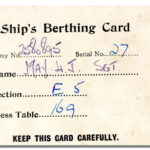
- Harry May’s berthing card for the ‘cruise’ to India
-
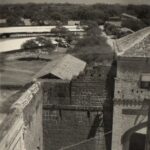
- Ahmednagar Fort, India, 1942
-
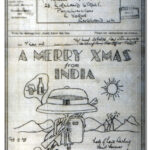
- Airgraph Christmas card, 1942
-
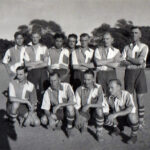
- 2nd Divisional Signals Football Team, India, 1942
-

- India, 1943
-

- Sergeant Harry May
-

- Airgraph Christmas card, 1944
-
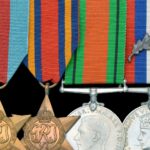
- 1939-45 Star, Burma Star, Defence Medal and British War Medal 1939-45 with Mention in Despatches emblem
‘D’ Section, 2nd Divisional Signals, India, 1942
-
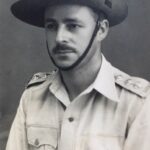
- Captain F. S. Martin, 2nd Divisional Signals, India, 1942
-
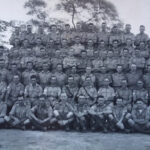
- ‘D’ Section, 2nd Divisional Signals, India, Christmas 1942
-

- Drivers, ‘D’ Section, 2nd Divisional Signals, India, Christmas 1942
-
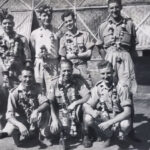
- Linemen, ‘D’ Section, 2nd Divisional Signals, India, Christmas 1942
-

- Operators, ‘D’ Section, 2nd Divisional Signals, India, Christmas 1942
1. (Back) London Gazette (LG) 7 April 1804; 15691, p. 437. For more information see page 434.
2. (Back) Later Special Force Chief Signal Officer during the 2nd Chindit Expedition, for which he was appointed an OBE. Later Brigadier C. C. Fairweather CB, CBE.
3. (Back) Convoy WS18 departed Liverpool and the Clyde on 15 April and sailed via Freetown, Sierra Leone (29 April-4 May) and Capetown/Durban, South Africa (18 May-23 May) to Bombay, arriving on 7 June. See Naval History.
4. (Back) LG 19 September 1946; 37730, p. 4697.
5. (Back) The awards to 2nd Divisional Signals for the Burma Campaign amounted to one OBE, two MBEs, one Military Cross, three Military Medals and no fewer than four Mentions in Despatches. It is certain that many more all ranks of the unit were mentioned in despatches but they have not been identified by name.
Dear Nick,
Thank you so much for your article about my dad Harry May. Dad never spoke to me about the war so apart from the stuff mum had kept in a box I knew nothing.
I’m sure that many other heroes from the war were the same. Dad died of a heart attack when he was 56. I was 23 at the time and because I was away on holiday, camping in Norfolk (mobile phones had not been invented), I didn’t know for several days.
The stuff I sent you was kept in a cardboard box in the loft and I didn’t know about it until mum died. It consisted mostly of photos, letters and mum’s personal stuff from before the war. There was no sign of his medals or any of his personal stuff. I suspect that my sister took them along with a gold pocket watch from dad’s father. I have lost contact with my sister so am unable to find out any more. My younger brother died when he was 56 years old (the same age as dad) and his wife told me that they had not been given anything when dad died.
Dad was strict with us kids but I don’t remember ever being smacked. He was a heavy smoker (probably as a result of the cigs given to all soldiers) and it’s ironic and sad that many of them will have died prematurely because of that.
Before he was called up he worked with his dad (also Henry) in an office, in a coal mine near Glasgow and I think he would have enjoyed getting away and seeing the world outside Glasgow, but when he met mum via an army mate in York he found the love of his life as you can see from his letters. I remember arguing with dad about politics. We lived in a council house and I couldn’t understand why he voted Conservative because we didn’t have a telly or a car—the wisdom of youth. He was a driver for a local chemist before he became an ambulance driver (a job he loved ). The church was packed for his funeral.
I hope you don’t mind me rambling on like this but there must be hundreds of old buggers like me who wish they could have taken the time to ask their dads about the war and their early lives and thank them for what they did for us all.
Kind regards
(Henry) Craig May.
Craig,
Thanks very much for the picture you paint of your dad. I think we all would have liked to have chatted to our dads more; I certainly do.
Nick