
My great-grandfather, Sergeant William Neill DCM, served with 9th Royal Irish Fusiliers—Blacker’s Boys—during the First World War. One hundred years ago he returned to the Somme, to Thiepval, for the dedication of the Ulster Battlefield Memorial Tower. This is an account of the events and includes a gallery of the memorabilia that he kept. It also includes a scene-by-scene description of the news clip filmed for Pathé News, in which he appears at the very end.

Ulster Tower
The Ulster Battlefield Memorial Tower was proposed in November 1919 by Sir James Craig MP. Based on Helen’s Tower at Clandeboye in County Down, it was designed by Bowden and Abbott Ltd of London[1] and built quickly by Fenning & Co Ltd, specialists in granite memorials, and the Société de Construction et Travaux Publics d’Arras. (See the plans here.) The land had been purchased from three families that farmed the area around Thiepval. The Ulster Tower, as it has become known, was the first official memorial raised on the Western Front—it was opened and dedicated on Saturday 19 November 1921. The tower is owned by the Somme Association and you can read more about its centenary here.
The level of planned representation indicates the importance of the ceremony. The original intention was for the Prime Minister of Northern Ireland, Sir James Craig, to welcome the visitors and for Lord Carson to unveil the commemorative tablet in the memorial chamber but both were ill and unable to attend.[2] The party that travelled to the ceremony numbered about 100, including Field Marshal Sir Henry Wilson Bt., G.C.B., D.S.O., Chief of the Imperial General Staff, representatives of all of the battalions of the division and some widows and mothers of the fallen. A list of those who attended and participated in the ceremony may be found here.
A newspaper appeal had been published on Friday 28 October 1921 to raise the funds required to send to the ceremony representatives of the units of 36th (Ulster) Division that fought on 1 July 1916. As a result a large contingent of men was sent (the linked document includes information about the signatories of the original appeal in addition to details of the men sent).
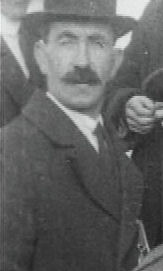
Sergeant William Neill DCM, Ulster Tower, 1921
The trip was organised by Cook’s Tours and my great-grandfather and his colleagues travelled to England on the 9.00pm Heysham ferry on Wednesday 16 November and then by train the following morning to London, where they stayed at the Imperial Hotel, Russel Square (see the gallery for the original programme for the trip). On Friday 18 November they travelled to Dover, sailed for Calais, and travelled by train to Amiens. There they were greeted by the mayor and senior French Army officers, a guard of honour and a large crowd. A military band played the national anthem of both countries. The visitors stayed overnight in Amiens. It was originally planned that Major General Nugent would give an account of the Thiepval attack during the ceremony but, due to constraints on time, it was decided that he would speak at a meeting at the Hotel du Rhin the evening before. His overview was very well received, as were the additional comments by Captain C. C. Craig M.P., the brother of Sir James Craig—he was a company commander during the attack and had been wounded and captured. Field Marshal Sir Henry Wilson spoke about the war generally. It is unlikely that many of the audience who had been at Thiepval or Hamel on 1 July 1916 would otherwise have heard about the attack from their perspective.
The next morning, which was frosty but clear, the visitors departed from Amiens in a convoy of motor cars and charabancs. The journey, about thirty miles, was at first uneventful and no signs of the destruction wrought by the war were obvious. As the convoy approached Albert, however, that changed. Albert was still in ruins—not one building that stood in 1914 had survived—and beyond the town the roads were badly cut up. As the convoy approached the memorial along a narrow road (now the D73) the devastation of Thiepval Wood and the British and German trenches could be seen, altered little since the end of the war. The whole event was thoroughly described in the Belfast Newsletter of Monday 21 November, which recorded a first impression of the tower:
‘Like Helen’s Tower it is ‘dominant over sea and land,’ and in the glittering sunshine which flooded the landscape on Saturday, relieving it of much of the drabness which the ravages of war have imposed on it, the building looked exceedingly beautiful.’[3]
The ceremony was due to begin at 11.00am but was delayed by about an hour because a car bringing some of the visitors from Amiens had broken down. This gave the visitors the opportunity to look at the trenches nearby. The area was littered with rusting rifles, helmets, and the detritus of war, including items of clothing, reflecting the fighting that had ebbed and flowed over this ground for four years. The barbed wire that still protected the trenches caught and ripped the coats of the unwary.
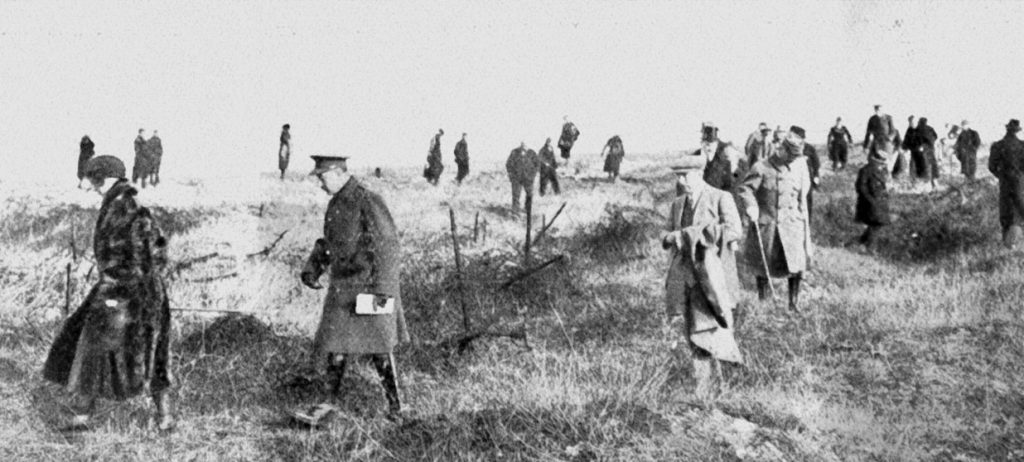
Participants at the dedication ceremony viewing the battlefield
A French guard of honour was in place for the arrival of Field Marshal Sir Henry Wilson, who inspected the troops as he walked to the tower accompanied by General Maxime Weygand, the former chief of staff to Marshall Foch.
Major J. C. Boyle, who had been commissioned into the 9th Royal Irish Fusiliers on its formation and transferred to the Corps of Royal Engineers in 1915, was an original member of the memorial committee and stood in for Sir James Craig. He formally asked Field Marshal Sir Henry Wilson to open the tower—the silver key was presented to the Field Marshal in a casket inscribed:
Presented to Field-Marshal Sir Henry M. Wilson, Bart., G.C.B., D.S.O., Chief of the Imperial General Staff, first Colonel Commandant of the Royal Ulster Rifles, on the occasion of the opening by him of the Ulster Battlefield Memorial Tower at Thiepval, 19th November, 1921, on behalf of the subscribers.
The Field Marshall then addressed the French troops and the French visitors to the ceremony in French, after which the memorial committee and senior visitors went into the memorial chamber. The memorial chamber, sixteen feet along each side, has a lintel around the room inscribed with words written by Lord Tennyson of Helen’s Tower:
Helen’s Tower here I stand,
Dominant over sea and land.
Son’s love built me, and I hold
Ulster’s love in lettered gold.
Here General Weygand unveiled the commemorative tablet, made of white marble.
Thereafter followed a service of dedication led by the Primate of All Ireland, the Most Reverend Dr C. D’Arcy, the Moderator of the Presbyterian Church, the Right Reverend Dr W. J. Lowe, and the President of the Methodist Church in Ireland, the Reverend W. H. Smyth. All spoke at length about the men of the Ulster Division and their achievements and also of the ‘cause of Ulster’. At the end of the service of dedication Lieutenant Colonel Sir William Allen formally handed over the custody of the tower to the committee of the Ulster Volunteer Force Patriotic Fund, represented by Sir Robert Liddell. Both men spoke and then, following a final benediction, the national anthem was sung.
To cheers from the crowd, the Duchess of Abercorn appeared on the tower roof and proceeded to unfurl a Union Flag and the French Tricolour; both were then raised together. In front of the tower were laid numerous wreaths and the final act was conducted by the representatives of the units and organisations associated with 36th (Ulster) Division, who planted trees brought from Ireland to form an avenue leading to the tower from the road. A list of those who planted the trees, who included my great-grandfather, may be found here.[4] Unfortunately, the trees and shrubs proved unsuited to the chalky soil and were replaced with hardier plants in the 1930s. In turn, during the Second World War these could not be tended and many succumbed to disease. They were later replaced with an avenue of ornamental purple plum trees. During the refurbishment of the Tower in the late 1980s Irish yew trees were planted.
The event was filmed for Pathé News and may be found in the archive of British Pathé. Titled ‘Ulster Cenotaph to Her Heroic Dead’ the clip runs for one minute and 15 seconds (due to the prohibitive cost of licensing this item, readers should view it on the Pathé News site or on the Pathé channel on Youtube):
0-8 seconds: The title shot.
9-17 seconds: Field Marshal Sir Henry Wilson walks between the ranks of the French guard of honour accompanied by the guard commander on his left and General Weygand on his right.
18-32 seconds: A view of some of the guests and participants during the remarks by Field Marshal Sir Henry Wilson, who opened the tower. On his right, from the right: Duchess of Abercorn, Lady French, Captain C. C. Craig M.P., and Lieutenant Colonel Sir William Allen K.B.E., D.S.O., M.P. On his left, from the left: The Lord Archbishop of Armagh and Primate of All Ireland, Most Reverend Dr C. D’Arcy; the Moderator of the General Assembly of the Presbyterian Church in Ireland, Right Reverend Dr W. J. Lowe (somewhat hidden); and the President of the Methodist Church in Ireland Reverend W. H. Smyth. Behind on the right, from left: Reverend C. C. Manning M.C. and Reverend J. A. Carey.
33-52 seconds: A general view of the guests and the tower while the unveiling of the memorial tablet was taking place inside.
53-59 seconds: The service of dedication led by the Primate of All Ireland (on the steps with Reverend W. H. Smyth behind him) and, in front, Reverend C. C. Manning M.C. and Reverend J. A. Carey.
59-67 seconds: Field Marshal Sir Henry Wilson with, on the far right, Frederick Hamilton-Temple-Blackwood, Marquess of Dufferin and Ava, D.S.O., P.C., and his wife.
68-75 seconds: Sergeant Joseph Savage, formerly Royal Irish Rifles, and his French wife, the first caretakers of the tower. At the end, appearing from the left and turning to face the camera, is my great-grandfather, Sergeant William Neill D.C.M.
After the ceremony the visitors had lunch in Albert at the newly rebuilt salle de fêtes (the village hall), which was followed by several speeches and toasts. The following day, 20 November, most of the party toured the area of the local battlefields by car and my great-grandfather and his party returned to London on 21 November, again staying at the Imperial Hotel. On the night of 22 November they took the 11.00pm ferry from Heysham to Belfast, arriving there the following morning.
Gallery: The trip memorabilia kept by Sergeant William Neill D.C.M.
-

- The letter sent with the trip tickets.
-
- Cook’s Tour Ticket
-
- Ticket envelope
-

- Lunch ticket; two were given to each attendee from Belfast
-

- Room tickets for the Imperial Hotel, London for Sergeant E. Neill and Sergeant R. J. Martin
-

- Dress code
-
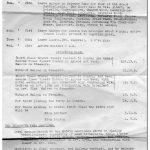
- Tour programme and administration given out on the Heysham ferry
-

- Detailed tour itinerary
-
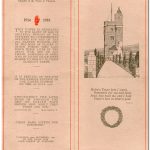
- Official programme (cover)
-

- Official programme (inside)
-

- Lunch Menu, Albert, 19 November 1921
-

- Lunch Menu, Albert, 19 November 1921
-

- Souvenir business cards
-
- Souvenir postcard – Amiens Cathedral
-
- Souvenir postcard – Peronne
-

- Souvenir postcard – Verdun Cathedral
Gallery: The tree markers:
-

- 9th Royal Irish Fusiliers tree marker
-
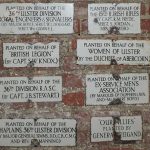
- Original tree markers
-
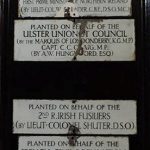
- Original tree markers
-
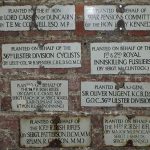
- Original tree markers
-
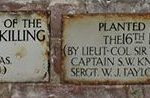
- Original tree markers
Gallery: The ceremony:
-
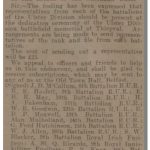
- Letter appealing for money to send unit representatives to the dedication of the Ulster Tower
-

- Sergeant William Neill DCM, Ulster Tower, 1921
-

- The French guard of honour before the ceremony
-
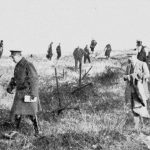
- Participants at the dedication ceremony viewing the battlefield
-
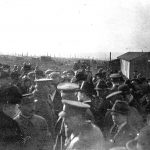
- Guests at the Ulster Tower, November 1921
-
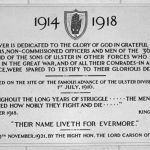
- The memorial plaque inside the Ulster Tower
-

- Wreaths at the Ulster Tower. The large white wreath in the centre is in the shape of a crown. It was laid by the Ulster Ex-Servicemen’s Association.
-
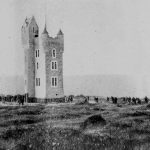
- Ulster Tower, November 1921
-
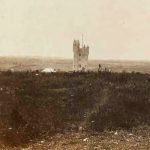
- Ulster Tower
1. (Back) Mr. James Albert Bowden F.R.I.B.A. and Lieutenant Colonel Albert Leigh Abbott M.C., T.D., F.R.I.B.A.
2. (Back) Having been prepared before his illness, it is Lord Carson’s name that is inscribed on the memorial tablet.
3. (Back) Belfast Newsletter, 21 November 1921, pp. 5-8.
4. (Back) This has been compiled for several sources including the list on the wall of the memorial room and numerous newspaper accounts.