
This blog post originally appeared in 2016 on my website dealing with Royal Signals honours and awards. With the closure of that site I have updated it and moved it here.

The medals of Lance Sergeant D. E. Ward M.C.
After the 1993 review of decorations and medals for gallantry, the Military Cross replaced the Military Medal as the third level award for non-commissioned officers and other ranks. Prior to 1993 there were 98 Military Crosses, including two bars, awarded to officers of the Corps, one award to a warrant officer during the Second World War and one to a warrant officer during the Borneo Confrontation. In addition, there were several awards to officers of the Indian Signal Corps serving alongside their Royal Signals counterparts in actions in North Africa, the Italian Campaign and Burma. Since 1993 there has been only one Military Cross awarded to a Royal Signals non-commissioned officer—to Sergeant N. J. Hillyard in 2016.[1] He is not, however, the first N.C.O. of the Corps to wear the ribbon of the Military Cross.
In India on the evening of Saturday 1 February 1936, two N.C.O.s of Kohat District Signals were returning to camp in a motor-cycle and sidecar along a mist-covered road east of the town when they hit a bullock cart—one was killed and the other badly injured.[2] The dead man was Lance Sergeant D. E. Ward M.C., an attached N.C.O. from ‘A’ Corps Signals.[3]

Kohat District Signals (Lance Sergeant D. E. Ward M.C. is on the left)
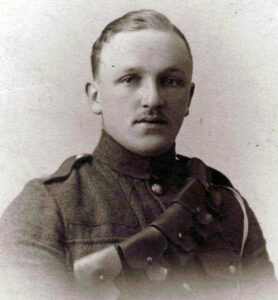
17714 Private Dennis Ward, 20th Hussars, 1915
Dennis Ward was born in Derby on 15 March 1895, the son of a well-known pig dealer. Just after the outbreak of the First World War he enlisted and in May 1915 he arrived in Flanders to join 20th Hussars, part of 5th Cavalry Brigade in 2nd Cavalry Division.[4] He did not stay long with the regiment, being selected for a commission and dispatched for officer training in November that year. On 27 December, Ward was commissioned into The Northumberland Fusiliers. The regiment became the second largest during the First World War, and amongst the 45 battalions raised after 1914 were the eight battalions (four each) of the Tyneside Scottish and Tyneside Irish. Ward was destined to join a battalion of the former. He did not join his battalion immediately, however, remaining in England with the 29th (Reserve) Battalion (Tyneside Scottish) when the four battalions of the Tyneside Scottish that made up 102nd Brigade went to France with 34th Division in January 1916.[5]
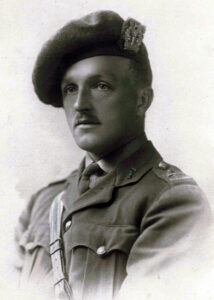
Second Lieutenant D. E. Ward, The Northumberland Fusiliers (Tyneside Scottish)
During the attack at Marsh Valley near La Boiselle on the first day of the Battle of the Somme, 20th (Service) Battalion (1st Tyneside Scottish) suffered severe casualties—all the officers were killed or wounded.[6] Ward was posted to that battalion in one of the reinforcement drafts after the battle. He served with the battalion in the latter part of 1916 and through 1917. In February 1918, the 1st and 2nd Tyneside Scottish were disbanded as part of the reorganisation of the British Expeditionary Force and the officers and men were posted to the two surviving battalions in the brigade. Ward, to his great fortune, was dispatched elsewhere. He joined VI Corps Signal School for training as a battalion signals officer. In doing so avoided becoming one of the many casualties suffered by 34th Division and the Tyneside Scottish Brigade at Croisilles south of Arras when the German offensive began on 21 March 1918. The remnant of the division moved north to recuperate. On 2 April, Ward joined 23rd (Service) Battalion (3rd Tyneside Scottish) as Signals Officer and the same day 131 reinforcements arrived; for the next few days the battalion reorganised and retrained before moving into the line near Armentieres on 5 April.
The battalion would now face the second phase of the German offensive that began with a bombardment on 7 April, lasting until the German assault two days later. For the next three days the battalion was in action as the German offensive pushed north-west towards Bailleul. On the evening of 12 April, it was ordered to move to a new position in front of the De Seule-Neuve Eglise (Nieuwkerke) road[7] and to ‘restore the front line…’.[8] By the following morning, the new position had been wired and a tentative enemy attack was driven off. In the evening the enemy attacked in strength and pushed the Tyneside Scottish back. Lieutenant Ward was sent out on a patrol along the Neuve Eglise road to find out what was happening on the left flank, which he managed to do until he was wounded. He was evacuated for medical treatment, and on 1 May embarked for hospital in England. For his gallantry in this action he was awarded the Military Cross. The award was announced in the battalion’s war diary on 17 June and published in the London Gazette in September:
For conspicuous gallantry and devotion to duty. Whilst the enemy was delivering a violent attack and the situation on the left flank was obscure, this officer took out a reconnoitring patrol, and for an hour and a half, under very heavy fire, kept the enemy movements under observation, and sent back valuable messages. He continued his work until seriously wounded in the leg later in the evening.[9]
Ward relinquished his commission in February 1919. For his war service he was awarded the 1914-15 Star, British War Medal 1914-20 and Victory Medal. He rejoined the family’s hog business with his brothers but in March 1924 he enlisted into Royal Signals as a soldier (resigning his commission with effect from 18 March). After his training at Maresfield, Ward was posted to India where he served with ‘A’ Corps Signals and where he proved to be a handy sportsman, representing the unit at cricket and soccer. Promoted to corporal in April 1928 and lance sergeant in April 1932, ‘Tubby’ Ward was a popular member of the unit and his exploits regularly featured in The Wire.
Lance Sergeant Ward’s funeral at Kohat was well attended with representatives from ‘A’ Corps Signals and several other units and his grave was covered in a mass of floral tributes. Later a substantial grave marker was erected. Kohat Christian Cemetery is largely overgrown now, and it is not known if the grave marker is still in place. Soon after his death his medals were returned to the War Office; they were sent to his sister in September 1936. In addition to those described above, Ward had also been awarded the Service Medal of the Order of St. John.
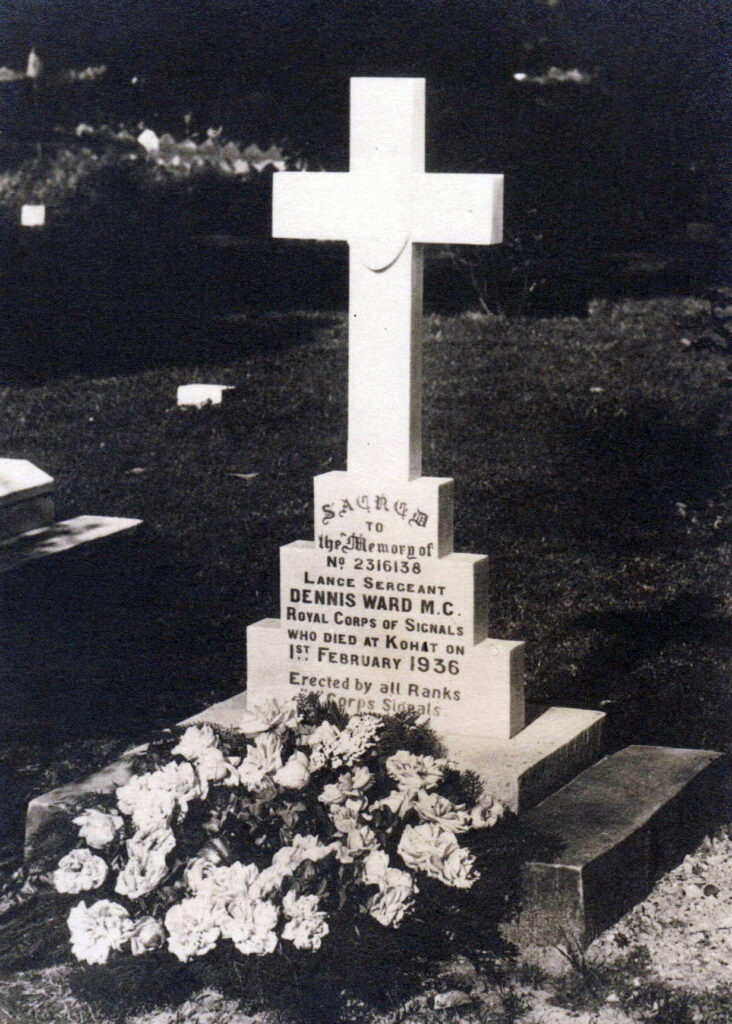
The grave of Lance Sergeant Dennis Edwin Ward M.C., Royal Signals
A second Royal Signals NCO also served as an officer during the First World War but with the Royal Naval Volunteer Reserve in 8th (Anson) Battalion in 188th Brigade, 63rd (Royal Naval) Division. After only six weeks in Flanders as a platoon commander in ‘B’ Company, Sub-Lieutenant William Stevenson took part in the attack by the brigade on 26 October 1917 north-west of the Passchendaele Ridge in support of the main attack by the Canadian Corps. The fighting was harsh—the day cost the battalion two officers killed, seven wounded and one missing, and 260 other ranks killed, wounded and missing—but against the odds Sub-Lieutenant Stevenson with the remnants of his platoon captured Varlet Farm[10] (a little over a mile north-west of Tyne Cot Cemetery). The citation for his Military Cross recorded:
For conspicuous gallantry and devotion to duty in leading his platoon against a farm strongly held by the enemy. In spite of a stubborn resistance, and heavy losses, he finally succeeded in capturing the farm, with seven men—all that remained of his platoon. Although nearly surrounded by the enemy, he held the position until relieved that night[11]
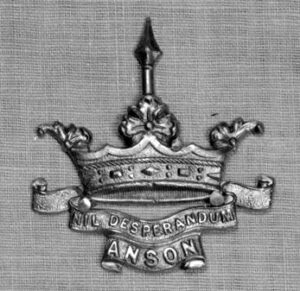
The Anson Battalion cap badge
William Howard Stevenson was born in Salford, Lancashire on 7 December 1893, where he later qualified as an electrical engineer. When war broke out, he enlisted into The King’s (Liverpool Regiment) and joined the 13th (Service) Battalion in 25th Division but before the division had embarked for France in September 1915, he had transferred to the Divisional Cyclist Company with which he served as a lance sergeant. When the company was reorganised in May 1916, he was transferred to The Loyal North Lancashire Regiment, posted to the 9th (Service) Battalion in 74th Brigade and promoted to sergeant.[12] Recommended for a commission, he left France in the summer of 1917 and attended No. 21 Officer Cadet Battalion at Fleet in Hampshire. Stevenson was commissioned as a temporary sub-lieutenant on 30 May and after a period at the 3rd (Reserve) Battalion at Blandford, in September he arrived in Flanders and joined the Anson Battalion. In March 1918 Stevenson was at home on leave when he fell ill and was admitted to hospital. Diagnosed with severe gastritis, a medical board in May judged him unfit for general service until he had been treated further. On 25 May, King George V presented him with his Military Cross at an investiture at Buckingham Palace. Stevenson did not return to the front but served at home, including a period from April 1919 with the Ministry of Labour attached to No. 3 District Officer University & Technical Courses, until he was demobilised on 29 June 1919.[13] For his war service he was awarded the British War Medal 1914-20 and Victory Medal.
After he was demobilised (and married), he enlisted as a soldier and joined Royal Signals in its earliest days.[14] Promoted to lance sergeant in September 1921 he served at Abbassia with Egypt Command Signals (where his daughter was born in August 1922 and where his infant son died in December 1923) and where he was made acting sergeant in January 1925. After a period in Yorkshire (where a son was born in 1926), he was posted to India in 1929 and joined 1st Indian Divisional Signals at Upper Topa, and where he was promoted to company quartermaster sergeant in March 1933.
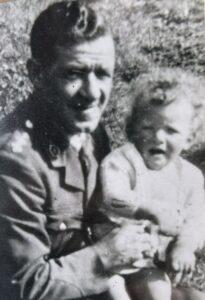
Captain (T.M.O.) W. H. Stevenson M.C. with one of his daughters early in the war.
Stevenson left India in early 1934 bound for the Signal Training Centre at Catterick where, sadly, his wife died in December that year.[15] Stevenson joined 3rd Divisional Signals in July 1935 and was promoted the following September, after which he served as the company sergeant major of No. 1 Company. In 1938 he was posted to 5th Divisional Signals, where he was serving on the outbreak of the Second World War. While at Bulford in November 1938 he remarried;[16] the couple had two daughters. He was commissioned as a Technical Maintenance Officer on 9 September 1939 (inexplicably he transferred to the Royal Army Ordnance Corps in July 1941 and back to Royal Signals in April 1942).[17] Subsequently promoted to captain, his career ended when he was dismissed the Service by sentence of a General Court Martial on 20 October 1943. He died as a result of a brain tumour in early 1946.
Acknowledgements:
Mary Wortley for permission to use the photographs of her great-uncle Dennis Ward M.C.
Chris Delacourt for permission to use the photographs of his grandfather William Stevenson M.C.
-
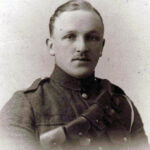
- 17714 Private Dennis Ward, 20th Hussars, 1915
-
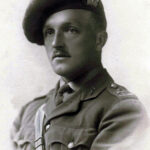
- Second Lieutenant D. E. Ward, The Northumberland Fusiliers (Tyneside Scottish)
-
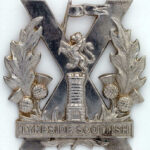
- The Tyneside Scottish Cap Badge
-
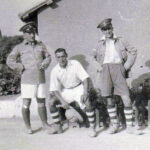
- Kohat District Signals (Lance Sergeant D. E. Ward M.C. is on the left)
-
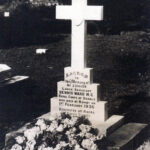
- The grave of Lance Sergeant Dennis Edwin Ward M.C., Royal Signals
-
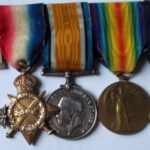
- The medals of Lance Sergeant D. E. Ward M.C.
-

- Captain (T.M.O.) W. H. Stevenson M.C. with one of his daughters early in the war.
-
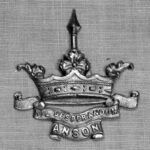
- The Anson Battalion Cap Badge
1. (Back) London Gazette 18 March 2016; 61529, p. 6082.
2. (Back) See: The Wire, April 1936, p. 152. The injured NCO was 2313843 Sergeant Ronald Arthur Douglas Sprunt (2 April 1903-March 1974).
3. (Back) 2316138 Lance Sergeant Dennis Edwin Ward M.C.
4. (Back) 17714 Private.
5. (Back) For an excellent account of the four battalions in the First World War see: Stewart, G. & Sheen, J. (2014). Tyneside Scottish. Barnsley: Pen and Sword.
6. (Back) The battalion’s war diary records 10 officers killed in action, 10 wounded and seven missing, and 62 other ranks killed in action, 305 wounded and 267 missing. The final tally for the officers would be 17 killed in action and 10 wounded.
7. (Back) Today the N331.
8. (Back) The National Archives. War Office: First World War and Army of Occupation War Diaries, 23 Battalion Northumberland Fusiliers. WO 95/2463/2.
9. (Back) London Gazette 16 September 1918; 30901, p. 11030.
10. (Back) Today the farm is a popular bed and breakfast destination.
11. (Back) Announced on a Divisional Routine Order on 20 November 1917. Published: London Gazette 17 December 1917; 30431, p. 13184. Citation: London Gazette April 1918; 30645; p. 4881.
12. (Back) Stevenson served as: 19299 Lance Corporal, The King’s (Liverpool Regiment); 6047 Lance Sergeant, Army Cyclist Corps; and 25133 Sergeant, The Loyal North Lancashire Regiment.
13. (Back) The Department of Officer University & Technical Courses was responsible for the placement of disabled officers onto education and training courses.
14. (Back) 2306007 Signalman William Howard Stevenson M.C.
15. (Back) Lilian Young was born in Lancashire in 1894. The couple married there in the second quarter of 1919. Lilian Stevenson died in York on 20 December 1934.
16. (Back) Dorothy Helena Batten was born in Wiltshire in 1912. The couple married in Salisbury on 21 November 1938. Dorothy Stevenson died in Wiltshire in 2002.
17. (Back) 100626 Lieutenant W. H. Stevenson M.C.
Hello Nick, very interesting article. My grandfather on mother’s side was William Howard Stevenson who won the Military Cross at the battle of Varlet Farm. My mother, who is now 80, is Angela Fahie nee Stevenson who was born in Farley village near Salisbury in 1944; she had one older sister, Susan. Her mother Dorothy met William at a tea dance in Salisbury and they moved to Winterslow village near Salisbury from Bulford after his court martial I believe. Dorothy had generations of family in those villages. My mom remembers him as a kind man. Although he died when she was a toddler she has memories of sitting with him on his bed when he was unwell. He suffered from headaches and it turned out to be a brain tumour. Nobody really knew why he was court martialled as it was never discussed openly although rumours to be to do with some misuse of equipment with him taking responsibility as officer. He is buried at Winterslow church. His eldest son from his first marriage (US citizen now passed away) erected a gravestone about 30 years ago but it has really faded (I live overseas have not tidied it up in a few years but will do on next return to UK). The military cross and other service medals are with the son’s family in Texas I believe. We intend (myself, brother and mom) to stay at Varlet Farm for a few days next year. I have a photo of William in uniform with his first daughter and there is another of him with his platoon my mom has.
Kind Regards Chris Delacourt.
Hello Chris,
Thanks very much for adding to the tale. I do appreciate it when family members offer ‘colour’ to these facts – I am of course writing about real people. I would indeed like to have a copy of your photo. I have sent you an email separately.
Nick