
During a recent visit to India with ‘The Forgotten War Tour’ led by Dr. Robert Lyman MBE and organised by Bertie Alexander of Sampan Travel, I was able to visit the Commonwealth War Graves Commission cemeteries in Kolkata, Kohima in Nagaland and at Digboi in Assam. Here are the Royal Signals casualties that lie in the former, and at the end some interesting graves & stories. Thanks to Rabi Singh for the photos I missed. Thanks also to Nigel Sly for the information about Carpenter Leo John Galvin.
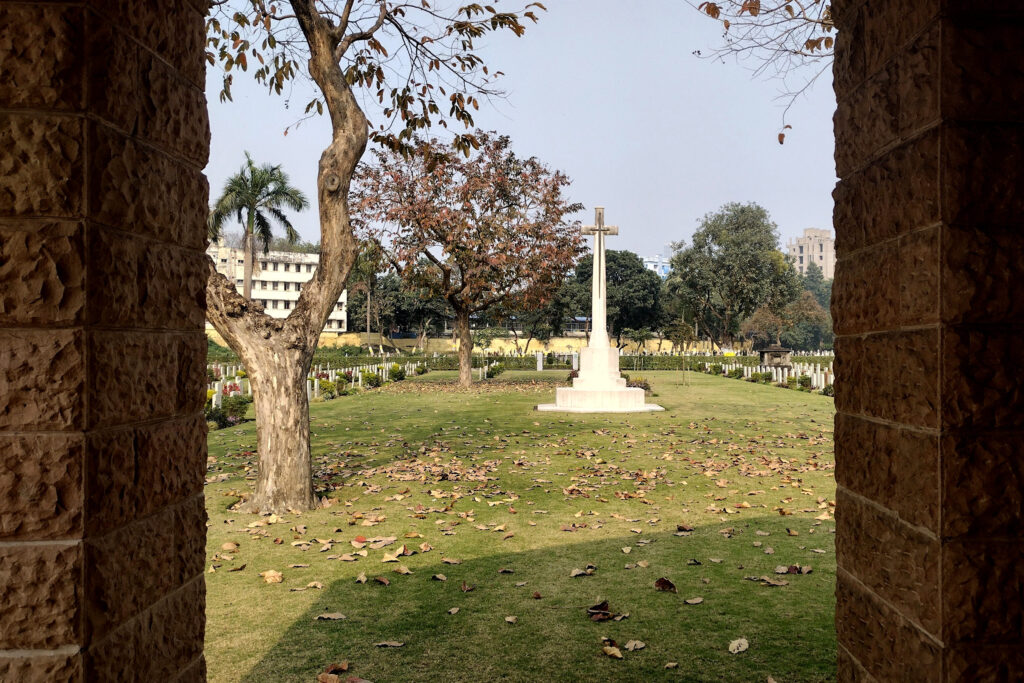
The Cross of Sacrifice
Bhowanipore Cemetery in Kolkata lies one kilometre south of the Maidan and is accessed from Debendra Lal Khan Road. The Commonwealth War Graves Commission section is at the rear (western) part of the cemetery. In addition to war graves from the First and Second World Wars, it includes over 230 non-World War graves from the 19th and 20th centuries. The CWGC section was established in its present form in the 1950s when graves from other parts of the cemetery were concentrated. It is beautifully tended by the head gardener Rabi Singh.

Head Gardener, Rabi Singh
During the Second World War, No. 47 British General Hospital was in Kolkata from January 1943 to the beginning of February 1945; it was replaced by No. 21 British General Hospital in January 1945. Also established in Kolkata was No. 119 Indian General Hospital (Combined). All of the 15 Royal Signals (and one Indian Signal Corps) casualties died in those hospitals as a result of disease or natural causes, or as a result of accidents in the Kolkata area.
Royal Corps of Signals and Indian Signal Corps

6105402 Driver JOHN HERBERT BUTLER
No. 1 Special Communications Group Signals
Died on 10 March 1944 in British General Hospital, Calcutta
as a result of injuries sustained in an accident.
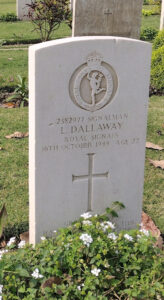
2382977 Signalman LEONARD DALLAWAY
Eastern Command Signals
Died on 16 October 1944 as a result of injuries sustained in a road traffic accident, aged 22.
GREATER LOVE HATH NO MAN THAN THIS, THAT HE GIVETH HIS LIFE FOR HIS FRIENDS

2572014 Lance Serjeant JOHN HARRY DOWNER
Eastern Command Signals
Died of disease/natural causes on 17 October 1944
at No. 47 British General Hospital, Calcutta, aged 24.
IN GOD’S GARDEN OF REST UNTIL WE MEET AGAIN
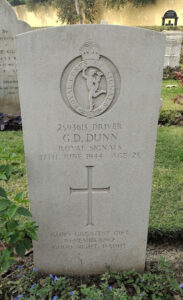
2593613 Driver GEORGE DALGLISH DUNN
Eastern Command Signals
Died of smallpox on 17 June 1944, aged 25.
GOD’S GREATEST GIFT, REMEMBRANCE. GOOD NIGHT, DADDY

14878720 Signalman RONALD HESKETH
Eastern Command Signals
Reported missing, his body was recovered on 7 January 1946 and it was determined that he had drowned while swimming when off duty. His death is recorded as having occurred on 8 January.
THY PURPOSE, LORD, WE CANNOT SEE BUT ALL IS WELL THAT’S DONE BY THEE

2356187 Signalman JAMES KELLY
4th Corps Signals
Died of disease/natural causes on 28 September 1944
at No. 47 British General Hospital, Calcutta, aged 33.

14212248 Signalman EDGAR MARTIN LITTLEJOHN
118th Light Anti-Aircraft Regiment Royal Artillery Signal Section (at the time the regiment was based in Assam as part of 14th (West African) Anti-Aircraft Brigade)
Died of disease/natural causes on 13 March 1944
at No. 47 British General Hospital, Calcutta, aged 37.
“O TRUE, BRAVE HEART! GOD BLESS THEE,
WHERESO’ER IN GOD’S GREAT UNIVERSE THOU ART TO-DAY!”
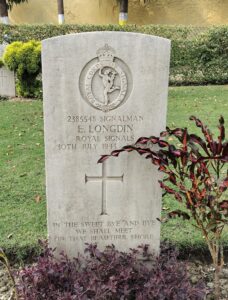
2385548 Signalman ELISHA LONGDIN
1st Indian Air Formation Signals
A former telegraphist with the General Post Office,
he drowned on 30 July 1943 while swimming when off duty, aged 20.
IN THE SWEET BYE AND BYE WE SHALL MEET ON THAT BEAUTIFUL SHORE

2582196 Corporal JAMES ROBERT MCDOUGALL
17th Indian Divisional Signals
Died of disease/natural causes on 2 July 1945, aged 25.
AT THE GOING DOWN OF THE SUN AND IN THE MORNING WE WILL REMEMBER YOU, JIMMY
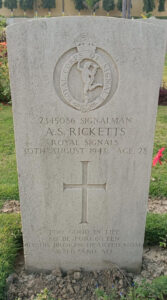
2345086 Signalman ALFRED SIDNEY RICKETTS
No. 98 Telegraph Operating Section, ‘T’ Indian Line of Communication Signals
Died of disease/natural causes on 30 August 1943
at No. 47 British General Hospital, Calcutta, aged 28.
TOO GOOD IN LIFE TO BE FORGOTTEN BY HIS BROKEN-HEARTED MOM, SISTER AND ALL

ISC/18716 Signalman SELLAPPAN
Indian Signal Corps, Unit Not Known
Died on 21 April 1944, aged 24.
ॐ भगवते नमः (Sanskrit: Om Bhagwate Namah—O my Lord; unto the Supreme Personality of Godhead I offer my respectful obeisances.)
THIS HINDU SOLDIER OF THE INDIAN ARMY IS HONOURED HERE

2342137 Lance Corporal LEONARD WILLIAM SMITH
4th Corps Signals
Died of cerebral malaria on 28 June 1943 at No. 47 British General Hospital, Calcutta, aged 27.
IN LOVING MEMORY OF MY DEARLY BELOVED HUSBAND “IN SPIRIT ALWAYS UNITED”

2593090 Signalman CYRIL LAWRENCE TEAGUE
17th Indian Divisional Signals
Died of disease/natural causes on 15 June 1945
at No. 21 British General Hospital, Calcutta, aged 29.
WITH TENDER LOVE AND DEEP REGRET WE WHO LOVED HIM WILL NEVER FORGET
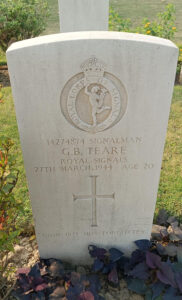
14274874 Signalman GUY BARRY TEARE
‘O’ Indian Line of Communication Signals
Died of smallpox on 27 March 1944 at No. 47 British General Hospital, Calcutta, aged 20.
GONE BUT NOT FORGOTTEN

5192180 Signalman FRANK THOMAS WEAVING
Eastern Command Signals
Died of disease/natural causes on 8 December 1942
at No. 47 British General Hospital, Calcutta, aged 26.
AT THE GOING DOWN OF THE SUN AND IN THE MORNING WE WILL REMEMBER HIM

2361790 Signalman LEONARD WILLCOX
53rd Heavy Anti-Aircraft Regiment Royal Artillery Signal Section
Died of smallpox on 11 February 1943 at No. 47 British General Hospital, Calcutta, aged 26.
“AS WE HAVE BORNE THE IMAGE OF THE EARTHY, WE SHALL ALSO BEAR THE IMAGE OF THE HEAVENLY”
Also buried here is:
ABRO/316 Captain FREDERICK GEORGE OLIVER
Burma Posts and Telegraphs Line of Communication Signals.
Died on 12 June 1942 (cause not known) after the withdrawal to India
during the Burma Campaign.
FATHER, IN THY GRACIOUS KEEPING LEAVE WE NOW OUR LOVED ONE SLEEPING.R.I.P.
Other Graves of Interest

Fireman E. G. Cole of the merchant ship Asphalion
Fireman EDWARD GARBO COLE, Merchant Navy
On 11 February 1944 Japanese submarine Ro-110 attacked a convoy on route from Ceylon to Calcutta (Sri Lanka to Kolkata). In the attack the armed merchant ship Asphalion was badly damaged and eight crew members were killed. Third Engineer Officer Alfred Gordon Curry, Greaser Thomas Williams and Firemen Victor A. Ailern, E. G. Cole, Tobler K. Williams and Tom Glasgow are buried in Bhowanipore Cemetery. Fourth Engineer Officer John McMaster Bulloch Ward and Carpenter Leo John Galvin have no known grave and are commemorated on Tower Hill Memorial: Ward was likely killed when the torpedo hit; his body was never recovered. Galvin was in his cabin above the engine room when the ship’s boiler exploded and he was horribly burned. The crew managed to get him into a lifeboat but he died from his injuries and was later buried at sea. Asphalion did not sink and the crew returned to the ship, which was taken under tow to Visakhapatnam, where repairs were made, and then towed to Kolkata.
While the officers and carpenter were from the United Kingdom, the other crew who died were from West Africa: Victor Ailern was from Lagos, Nigeria; Thomas Williams was born in Nigeria and Tom Williams was from Freetown, Sierra Leone but both men lived in Liverpool; Tobler Williams and Edward Cole were from Freetown, Sierra Leone. The grave of Edward Cole is inscribed “HUSH, BLESSED ARE THE DEAD IN JESUS’ ARMS WHO REST.” HIS SORROWING WIDOW CECILIA. R.I.P.
The Master of the Asphalion, Samuel Roland Evans, was made an O.B.E. in 1943 for his leadership when his previous ship, m.v. Medon, was sunk by the Italian submarine Reginaldo Giuliani on 10 August 1942 in the South Atlantic.[1] All of his crew survived and those in his lifeboat were picked up by the Portuguese steamer Luso. All of the crew in three other boats were also picked up by various ships, including the Second Officer and 15 men found by the British merchant ship Reedpool, which in turn was torpedoed and sunk by U-515 on 20 September. They survived this second attack and were picked up the next day by the British ship Millie M. Masher. Chief Officer George Edge and Second Officer John Frederick Fuller were made an M.B.E. Captain S. R. Evans O.B.E. died in Cornwall on 13 January 1949.

The Grave of Ensign R. E. Nelson A.T.S.
18560 Ensign RITA ELSIE NELSON, Women’s Transport Service (F.A.N.Y.)
Ensign Nelson is the only Auxiliary Territorial Service casualty commemorated in the cemetery and one of only two such commemorations in South Asia.[2] She died on 28 March 1946. Strangely she is commemorated as A.T.S. (F.A.N.Y.) and given her rank and number (18560) it is likely that she was in fact ‘Women’s Transport Service (F.A.N.Y.)’. A submission for this to be checked and amended has been sent to the C.W.G.C. Her grave is inscribed IN EVERLOVING MEMORY OF OUR DEAR DAUGHTER

Three soldiers of The Black Watch (Royal Highland Regiment)
The Black Watch (Royal Highland Regiment)
There are 16 members of 2nd Battalion, The Black Watch (Royal Highland Regiment) buried in the cemetery, 14 of whom drowned on 16 October 1942 when a cyclone destroyed company positions near Contai, close to where the Hooghly River enters the Bay of Bengal. Estimates vary with sources suggesting between 14,500 and 60,000 people killed. Notably, the cyclone greatly affected the important aman rice crop and exacerbated the impact of brown spot disease; the failure of this crop was a major contributing factor of the Bengal famine of 1943. The men were buried originally near where they drowned at a cemetery at Pichaboni, a village in the Purba Medinipur district of West Bengal and reinterred at Bhowanipore Cemetery on 17 October 1947.
For their bravery during the storm Captain P. LeButt, and Lieutenants A. E. Blair and J. C. Donaldson were made M.B.E.’s, and Corporal G. S. Ballantine and Private J. Herriot were awarded the British Empire Medal.[3] The battalion medical officer, Captain D. C. Langwell R.A.M.C. was accorded a citation in Indian Army Orders for his ‘valuable services’ during the incident. A memorial to those who died may be found in St Matthew’s Church, Tay Street, Perth.

The Grave of Master G. H. S. Prance D.S.C.
Master GWILYM HENRY STORKES PRANCE, D.S.C., Merchant Navy
Gwilym Henry Storkes Prance was the Master of the Ocean Gypsy, one of 60 cargo ships of the ‘Ocean’ class built in the United States and the predecessor of the Liberty Ship. He was awarded the Distinguished Service Cross in 1943 ‘For fortitude, seamanship and endurance in taking Merchantmen and Royal Fleet Auxiliaries to North Russia through heavy seas and in the face of many attacks by enemy aircraft and submarines.’[4] He fell ill and died in hospital in Calcutta on 11 February 1946, aged 50.

The Graves of Flying Officer W. Mooney D.F.C., D.F.M. and Leading Aircraftman G. P. Storey. Behind is the grave of Colonel A. W. Tufnell C.M.G, murdered in 1920.
Flying Officer WILLIAM MOONEY D.F.C., D.F.M, Royal Air Force Volunteer Reserve
Leading Aircraftman GEORGE POTTS STOREY, Royal Air Force Volunteer Reserve
and
Colonel ARTHUR WYNDHAM TUFNELL C.M.G., late The Queen’s (Royal West Surrey) Regiment
Flying Officer Mooney was awarded the Distinguished Flying Medal in 1943 while serving as a flight engineer with No. 50 Squadron, and was awarded the Distinguished Flying Cross in 1944 while serving as a flight engineer with No. 630 Squadron;[5] both squadrons were equipped with Avro Lancasters. In Calcutta he was serving as the Adjutant of No. 101 Repair & Salvage Unit and was reportedly murdered in Calcutta while off duty on 11 December 1945 (I have found no original official or news source to confirm this).
While serving with No. 54 Embarkation Unit (formerly R.A.F. Port Detachment, Calcutta), Leading Aircraftman Storey was seriously injured in a traffic accident on 9 December and was admitted to No. 21 British General Hospital, where he died on 11 December 1945.
Arthur Tufnell was commissioned into The Queen’s (Royal West Surrey) Regiment in 1891. He served in India in the Tirah campaign of 1897-98 and in the South African War, during which he was severely wounded at Colenso. For his service during the South African War he was three times mentioned in despatches.[6] After attendance at Staff College he served on the staff in the War Office, Scottish Command and immediately prior to the First World War with the East Lancashire Division. That division became 42nd (East Lancashire) Division, with which he served in Gallipoli and where he was wounded again. He commanded 126th Infantry Brigade in Egypt and France and then served in the United Kingdom on the staff of the 68th Division and 23rd Corps. For his war service, in 1916 he was appointed C.M.G and made a Chevalier of the Légion d’honneur. He was three times mentioned in despatches.[7] Contrary to the inscription on his grave, he was not awarded the Distinguished Service Order. In January 1920 he sailed for India to take up the appointment of General Staff Officer in 8th (Lucknow) Division. While travelling from Darjeeling to Simla on the Punjab Mail Express he was found unconscious with head wounds when the train stopped at Burdwan station (now Bardhaman Sadar), 70 miles from Calcutta. He was taken to hospital in Calcutta and briefly regained consciousness but died of his injuries on 17 May 1920. Despite a prolonged investigation, his murderer—believed to be a European—was never found.
1. (Back) For the awards to the officers of m.v. Medon with citations see London Gazette 28 September 1943; 36185, pp. 4291-4292.
2. (Back) The other casualty is W/306481 Corporal Mary Smith Fenwick who died on 3 September 1945 and is buried in Madras War Cemetery.
3. (Back) London Gazette; 9 July 1943; 36085, p. 3103. Recommendations: The National Archives—WO 373/68/25-28.
4. (Back) London Gazette; 16 February 1943; 35906, p. 825.
5. (Back) Distinguished Flying Medal—London Gazette 14 September 1943; 36170, p. 4079; Distinguished Flying Cross—London Gazette 13 October 1944; 36745, p. 4693.
6. (Back) Despatches—London Gazette 8 February 1901; 27282, p. 975 and p. 959 (reflecting General Sir Redvers Buller’s despatches of 19 June and 9 November 1900); and London Gazette 10 September 1901; 27353, p. 5937.
7. (Back) C.M.G.—London Gazette 2 February 1916, 29460 p. 1336; Légion d’honneur—London Gazette 24 February 1916, 29486 p. 2067; Despatches—London Gazette 5 November 1915; 29354, p. 10996; London Gazette 28 January 1916; 29455, p. 1196; and London Gazette 13 July 1916; 29664, p. 6944.
Thanks Nick. Much appreciated
My great x2 uncle is buried here. Died drowning trying to evacuate civilians in October 1942 during flooding. Sleep easy Edward Palmer, still remembered and loved.
3318252 Private Edward Palmer, 2nd Battalion, The Black Watch (Royal Highland Regiment).
Very interesting info on my great uncle Leo Galvin, Nick. I’ve been researching him and the Blue Funnel line for last four years. Recently discovered by complete chance a book which talks about the Asphalion and Leo (A love of Ships by George King) including his death in the life boat.
It doesn’t tell if he was buried at sea but it would make sense. Where did Nigel Sly get his info from as I’d love to know.
Hello Clive, I have sent you an email.
Nick