Category Archives: Gallantry

Lieutenant Luigi Parisotti, 4/39th Garhwal Rifles

As a researcher of military history, one of my greatest sources of satisfaction is the acceptance by the Commonwealth War Graves Commission of a correction to a record of commemoration. Mostly as a consequence of the digitisation process, such errors are legion. Additionally some casualties were missed for various reasons. My first success was the inclusion of one of Blacker’s Boys, the 9th Royal Irish Fusiliers, on the Addenda Panel at Thiepval; he was killed on 1 July 1916 but his death had not been recorded. For some years I have been examining the CWGC commemorations from the First World War in the United States and recently I have been working on a project to ensure the correct commemoration for all Royal Signals casualties. My latest success, however, was for an infantry officer killed in action in Waziristan whose date of death and regiment were recorded incorrectly; he was killed in a fight that earned another officer a posthumous Victoria Cross.

Lieutenant Luigi Maria Parisotti was born on 25 July 1891 in Paddington, London, the son of an Italian father and an English mother; he was the fourth of five children.[1] He was educated at Stonyhurst College; Collège Saint Pierre, Calais; and the Sorbonne.[2] At some time he began to use the name ‘Louis’.

Luigi Parisotti

Parisotti was commissioned into Alexandra, Princess of Wales’s Own (Yorkshire Regiment) on 2 September 1915. After a period with the 3rd (Reserve) Battalion at West Hartlepool, he joined the 2nd Battalion of the Green Howards near Carnoy in France as a platoon commander in ‘D’ Company in February 1916. The battalion was part of 21st Brigade in 30th Division, which had transferred from 7th Division the previous December and on doing so lost two of its regular battalions to other brigades in 30th Division, receiving two ‘Pals’ battalion in their place—18th (Service) Battalion, King’s (Liverpool Regiment) (2nd City) and 19th (Service) Battalion, Manchester Regiment (4th City). Continue reading →

Non-Commissioned Officers and the Military Cross

This blog post originally appeared in 2016 on my website dealing with Royal Signals honours and awards. With the closure of that site I have updated it and moved it here. 

The medals of Lance Sergeant D. E. Ward M.C.

After the 1993 review of decorations and medals for gallantry, the Military Cross replaced the Military Medal as the third level award for non-commissioned officers and other ranks. Prior to 1993 there were 98 Military Crosses, including two bars, awarded to officers of the Corps, one award to a warrant officer during the Second World War and one to a warrant officer during the Borneo Confrontation. In addition, there were several awards to officers of the Indian Signal Corps serving alongside their Royal Signals counterparts in actions in North Africa, the Italian Campaign and Burma. Since 1993 there has been only one Military Cross awarded to a Royal Signals non-commissioned officer—to Sergeant N. J. Hillyard in 2016.[1] He is not, however, the first N.C.O. of the Corps to wear the ribbon of the Military Cross.

In India on the evening of Saturday 1 February 1936, two N.C.O.s of Kohat District Signals were returning to camp in a motor-cycle and sidecar along a mist-covered road east of the town when they hit a bullock cart—one was killed and the other badly injured.[2] The dead man was Lance Sergeant D. E. Ward M.C., an attached N.C.O. from ‘A’ Corps Signals.[3]

Kohat District Signals (Lance Sergeant D. E. Ward M.C. is on the left)

Continue reading →

Gallantry During The Blitz – Robert Hamilton Tinto G.M.

This blog post originally appeared in 2016 on my website dealing with Royal Signals honours and awards. With the closure of that site I have updated it and moved it here. The events that it commemorates took place just over 81 years ago.

Signalman Robert Hamilton Tinto G.M.

On the evening of 29 December 1940, a German bombing raid on London caused what became known as the ‘Second Great Fire of London’. Most frequently illustrated by the iconic photograph of St Paul’s Cathedral that came to symbolise London in the blitz, the attack targeted the City of London and the high explosive and incendiary bombs started a firestorm that swept all before it. The area destroyed was more than that devastated by the Great Fire of 1666 and cost the lives of over 160 civilians and 14 firemen.[1]

St Paul’s Cathedral, 30 December 1940

Continue reading →

The Book Cover

This article was published originally in 2021 on my website dealing with Royal Signals Honours and Awards to describe the various photos on the book’s cover; having closed that website it is reproduced.

Designed by Jag Lal, the cover of Honours, Decorations, and Medals to The Royal Corps of Signals for Gallantry & Distinguished Service 1920-2020 shows seven images, with another making up the textured background.

Royal Signals dispatch rider in Waziristan, 1935

Left Top: A Royal Signals despatch rider in Waziristan, 1935. He is riding the military version of the 350cc Douglas Motors L3 which in India replaced the well-regarded Triumphs in the early 1930s. In 1932 Kohat District Signals reported in The Wire: ‘Since receiving our new pattern Fords, we have also had a new outfit of Douglas motor-cycles. The old Triumphs have passed out, much to our regret, and the steady purr of the Doug has come to stay.’[1] They were not as popular as the Triumphs and apparently not as reliable. 1st Indian Divisional Signals on exercise south-east of Rawalpindi in late 1932 recorded: ‘There was plenty of hard work for everyone, but the Douglas motor cycles could not stand up to the type of country over which they had to work and were all out of action before the ‘war’ proper commenced, leaving the three Triumphs to carry out the motor cycle D.R. work.’[2] By the Second World War they had been largely replaced by the Norton WD16H. Continue reading →

‘Darkest Hour’, Calais—Capture and Escape

This article was published originally in 2018 on my website dealing with Royal Signals Honours and Awards; it is reproduced here in anticipation of that website closing.

I suspect many of the readers here will have seen Darkest Hour and Gary Oldman’s superb performance as Churchill. One aspect of the final days of the fighting in France that gets a deserved mention in the film is the ill-fated defence of Calais by Brigadier Claude Nicholson’s 30th Motor Brigade. Ordered to hold out at all cost, the Brigade and French troops in the town fought bravely until, position by position, they were forced to surrender on 26 May 1940. Two German divisions were diverted from their attack on the Dunkirk perimeter.

Headquarters 30th Motor Brigade was split between an Advanced Headquarters in the Citadel in the Old Town and a Rear Headquarters in the docks’ railway station; the latter moved on the afternoon of 26 May to a small fort at the end of the quay. First of the two to fall was Rear Headquarters which was completely surrounded and being slowly reduced by accurate and heavy mortar fire. The Royal Signals element there, led by Lieutenant William Millett of the Brigade Signal Section, and remnants of 1st Battalion, Rifle Brigade and 1st Battalion, Queen Victoria’s Rifles surrendered at about 4.00pm. The Advanced Headquarters, defended by French troops and a small party of Royal Marines, was overrun between 4.30pm and 5.00pm; it was here that Brigadier Nicholson and the Brigade Major, Captain Dennis Talbot were captured.

Daily Record, Friday 31 May 1940

Continue reading →

Major Robert Norman Dodds MBE, MC, DCM, MM

This blog post originally appeared on my site dealing with Honours and Awards to Royal Signals. It is reposted here in anticipation of that site’s closure.

Second Lieutenant R. N. Dodds MC, DCM, MM, Russia, 1920

One hundred and two years ago, on 22 May 1920 the former Royal Navy hospital ship and troop transport SS Dongola arrived in England carrying some of the last British and French refugees to flee Bolshevik Russia. Amongst the passengers was also the final batch of British prisoners of war, who had been captured a year before during the operations in North Russia. One of their number was Second Lieutenant Robert Dodds MC, DCM, MM of the Royal Engineers Signal Service.

Dodds was commissioned into Royal Signals just prior to the Second World War and was made an MBE for his service in North Africa. I came across him while researching something completely different a few years ago and intrigued by his multiple decorations—he was one of only two men to receive this combination of awards[1]—I saved on my computer the London Gazette that recorded his retirement, meaning to return to it later. It became one of the catalysts that promoted my wider study of Royal Signals gallantry awards.

He is an excellent example of a significant number of decorated soldiers whose gallantry awards are, by necessity, consigned to a brief mention in the Register of Awards. It was an aspiration to record the awards made to those who earned them prior to joining Royal Signals but that has proven to be an impossible task to complete accurately. Nonetheless, the full story of Dodds’ repeated gallantry is worth recounting. Continue reading →

March 1918 – Sergeant James Hughes DCM, MM

The medals of Sergeant James Hughes DCM, MM

In March 1918, for the third time in 21 months, the 9th Royal Irish Fusiliers in 108th Brigade, 36th (Ulster) Division was all but destroyed. Blacker’s Boys devotes a whole chapter to the actions fought in the week following the German attack south of the River Somme and the subsequent action against the German second phase attack south of Ypres.

In these actions, 36th (Ulster) Division suffered over 7,200 casualties, of which over 5,600 were missing, most of whom had been captured. This was the highest casualty rate of any division facing the German attack. The 9th Royal Irish Fusiliers lost 46 killed or died of wounds, 142 wounded and an estimated 334 captured. By this stage of the war the Battalion was nothing like that which had landed in France in October 1915. The majority of its men were those who had joined from 2nd North Irish Horse, there was also a fair number of Englishmen—from Yorkshire, Derbyshire and London—and Irish soldiers from all over Ireland, both Catholic and Protestant.

Many of the men killed in the actions fought in March 1918 were later described as falling in the period 21-29 March or on 29 March but neither of these descriptions is wholly accurate. Continue reading →

21 March 1918 – Racecourse Redoubt

One hundred years ago, on 21 March 1918 on the first day of the German offensive that swept back the British Fifth Army, my great-uncle Robbie was captured in the ‘Line of Resistance’ at the very front of the defensive positions held by 15th Royal Irish Rifles in 107th Brigade in 36th (Ulster) Division. His story is here.

107th Brigade Forward Zone

‘Twice they got out on top and walked along it, clearing enemy out of it with rifle and rifle grenades.’

Farther back, ‘D’ Company held out in Racecourse Redoubt until that evening. During the attacks there in the morning, one of ‘D’ Company’s platoon commanders, Second Lieutenant Edmund De Wind, defended his position most gallantly and, assisted by Corporal Samuel Getgood and Lance Corporal Hubert Walker MM, repeatedly cleared the enemy from a trench at the west of the redoubt. Around midday De Wind was killed; Getgood and Walker were captured when the redoubt was surrendered that evening. For their gallantry De Wind was posthumously awarded the Victoria Cross and Getgood and Walker were awarded the Distinguished Conduct Medal.

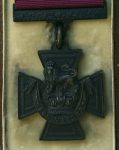
Recently I was able to help a descendent of De Wind put together some of his story, in preparation for a commemorative event in Comber, Northern Ireland, De Wind’s home town prior to his emigration to Canada. It is with his permission that I can show these fabulous photographs of his Victoria Cross. In 2019 Josh De Wind completed a fuller account of his great-uncle’s life—A Crown of Life—which you can read here.[1]


1. (Back) De Wind, J. (2019). A Crown of Life—Edmund De Wind, VC. Self Published.

Discovering The North-West Passage

Discovering the North-West Passage: The Four-Year Arctic Odyssey of H.M.S. Investigator and the McClure ExpeditionDiscovering the North-West Passage: The Four-Year Arctic Odyssey of H.M.S. Investigator and the McClure Expedition by Glenn M. Stein
My rating: 5 of 5 stars

This is an outstanding piece of work. Ignoring for one moment the incredible story of the crew of HMS Investigator, this 19th Century tale of exploration is superbly researched and documented; as a reference work for the serious student of the history of exploration in the Arctic and Antarctic it is a ‘must read’. The bibliography is extensive, the notes on the primary sources lend much weight to the author’s conclusions and the tale itself is well told, without hyperbole or flights of imagination. I ordered this from a library in order to study Stein’s history of the Polar Medal. Before beginning the book I read the notes on the sources and I’m glad that I did so first.

Although there is room for a lighter telling of this tale (which I think would please some of the reviewers of this book elsewhere) some events in history require a serious and scholarly study to be worthy of the efforts of those whom it describes and to sit as the definitive historical record. This is such a work and I highly recommend it.

View all my reviews

The East Coast Floods, 1953

As I work on my book about Royal Signals gallantry awards, the news is dominated by accounts of Hurricanes Harvey, Irma, Jose and Katia and the massive earthquake in Mexico. By coincidence, the section that I am writing is about the East Coast Floods of 1953.

Canvey Island, 1953

On 31 January 1953, an extremely heavy storm coupled with a high spring tide led to a devastating natural disaster in the low-lying areas around the North Sea. Sea defences were breached, coastal areas were flooded and ships were lost. Over 2,500 people were killed—1,836 in the Netherlands, 307 in England, 19 in Scotland and 28 in Belgium; 361 people were killed at sea, including 133 on the Larne-Stranraer ferry m.v. Princess Victoria. This was one of the worst natural disasters to hit the region; the rescue work took many days and recovery took many months.

There were numerous acts of gallantry recorded over the period and 102 British awards were made to civilians and military personal, including honorary awards to men of the United States Air Force stationed in East Anglia. These and the meritorious service awards that followed the rescue effort were spread over several editions of the London Gazette, including the Coronation Honours list; the honorary awards were not published. There were more British awards made in the aftermath of this disaster than for any other single, non-warlike event in British history. Continue reading →