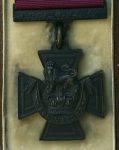
As a researcher of military history, one of my greatest sources of satisfaction is the acceptance by the Commonwealth War Graves Commission of a correction to a record of commemoration. Mostly as a consequence of the digitisation process, such errors are legion. Additionally some casualties were missed for various reasons. My first success was the inclusion of one of Blacker’s Boys, the 9th Royal Irish Fusiliers, on the Addenda Panel at Thiepval; he was killed on 1 July 1916 but his death had not been recorded. For some years I have been examining the CWGC commemorations from the First World War in the United States and recently I have been working on a project to ensure the correct commemoration for all Royal Signals casualties. My latest success, however, was for an infantry officer killed in action in Waziristan whose date of death and regiment were recorded incorrectly; he was killed in a fight that earned another officer a posthumous Victoria Cross.
Lieutenant Luigi Maria Parisotti was born on 25 July 1891 in Paddington, London, the son of an Italian father and an English mother; he was the fourth of five children.[1] He was educated at Stonyhurst College; Collège Saint Pierre, Calais; and the Sorbonne.[2] At some time he began to use the name ‘Louis’.

Luigi Parisotti
Parisotti was commissioned into Alexandra, Princess of Wales’s Own (Yorkshire Regiment) on 2 September 1915. After a period with the 3rd (Reserve) Battalion at West Hartlepool, he joined the 2nd Battalion of the Green Howards near Carnoy in France as a platoon commander in ‘D’ Company in February 1916. The battalion was part of 21st Brigade in 30th Division, which had transferred from 7th Division the previous December and on doing so lost two of its regular battalions to other brigades in 30th Division, receiving two ‘Pals’ battalion in their place—18th (Service) Battalion, King’s (Liverpool Regiment) (2nd City) and 19th (Service) Battalion, Manchester Regiment (4th City). Continue reading