Category Archives: Commemoration

Lieutenant Luigi Parisotti, 4/39th Garhwal Rifles

As a researcher of military history, one of my greatest sources of satisfaction is the acceptance by the Commonwealth War Graves Commission of a correction to a record of commemoration. Mostly as a consequence of the digitisation process, such errors are legion. Additionally some casualties were missed for various reasons. My first success was the inclusion of one of Blacker’s Boys, the 9th Royal Irish Fusiliers, on the Addenda Panel at Thiepval; he was killed on 1 July 1916 but his death had not been recorded. For some years I have been examining the CWGC commemorations from the First World War in the United States and recently I have been working on a project to ensure the correct commemoration for all Royal Signals casualties. My latest success, however, was for an infantry officer killed in action in Waziristan whose date of death and regiment were recorded incorrectly; he was killed in a fight that earned another officer a posthumous Victoria Cross.

Lieutenant Luigi Maria Parisotti was born on 25 July 1891 in Paddington, London, the son of an Italian father and an English mother; he was the fourth of five children.[1] He was educated at Stonyhurst College; Collège Saint Pierre, Calais; and the Sorbonne.[2] At some time he began to use the name ‘Louis’.

Luigi Parisotti

Parisotti was commissioned into Alexandra, Princess of Wales’s Own (Yorkshire Regiment) on 2 September 1915. After a period with the 3rd (Reserve) Battalion at West Hartlepool, he joined the 2nd Battalion of the Green Howards near Carnoy in France as a platoon commander in ‘D’ Company in February 1916. The battalion was part of 21st Brigade in 30th Division, which had transferred from 7th Division the previous December and on doing so lost two of its regular battalions to other brigades in 30th Division, receiving two ‘Pals’ battalion in their place—18th (Service) Battalion, King’s (Liverpool Regiment) (2nd City) and 19th (Service) Battalion, Manchester Regiment (4th City). Continue reading →

Major Robert Norman Dodds MBE, MC, DCM, MM

This blog post originally appeared on my site dealing with Honours and Awards to Royal Signals. It is reposted here in anticipation of that site’s closure.

Second Lieutenant R. N. Dodds MC, DCM, MM, Russia, 1920

One hundred and two years ago, on 22 May 1920 the former Royal Navy hospital ship and troop transport SS Dongola arrived in England carrying some of the last British and French refugees to flee Bolshevik Russia. Amongst the passengers was also the final batch of British prisoners of war, who had been captured a year before during the operations in North Russia. One of their number was Second Lieutenant Robert Dodds MC, DCM, MM of the Royal Engineers Signal Service.

Dodds was commissioned into Royal Signals just prior to the Second World War and was made an MBE for his service in North Africa. I came across him while researching something completely different a few years ago and intrigued by his multiple decorations—he was one of only two men to receive this combination of awards[1]—I saved on my computer the London Gazette that recorded his retirement, meaning to return to it later. It became one of the catalysts that promoted my wider study of Royal Signals gallantry awards.

He is an excellent example of a significant number of decorated soldiers whose gallantry awards are, by necessity, consigned to a brief mention in the Register of Awards. It was an aspiration to record the awards made to those who earned them prior to joining Royal Signals but that has proven to be an impossible task to complete accurately. Nonetheless, the full story of Dodds’ repeated gallantry is worth recounting. Continue reading →

September 11…

There is lots being written about what should and should not have been done after 9/11, the terrorist attacks in New York and Washington DC 20 years ago. It is worth, however, remembering the many thousands grievously impacted by the events of that day. My friend Susan Henson was working in the Pentagon when the hijacked American Airlines Flight 77 hit the western side of the building. For the first time she has told her story—it’s well worth reading.

March 1918 – Sergeant James Hughes DCM, MM

The medals of Sergeant James Hughes DCM, MM

In March 1918, for the third time in 21 months, the 9th Royal Irish Fusiliers in 108th Brigade, 36th (Ulster) Division was all but destroyed. Blacker’s Boys devotes a whole chapter to the actions fought in the week following the German attack south of the River Somme and the subsequent action against the German second phase attack south of Ypres.

In these actions, 36th (Ulster) Division suffered over 7,200 casualties, of which over 5,600 were missing, most of whom had been captured. This was the highest casualty rate of any division facing the German attack. The 9th Royal Irish Fusiliers lost 46 killed or died of wounds, 142 wounded and an estimated 334 captured. By this stage of the war the Battalion was nothing like that which had landed in France in October 1915. The majority of its men were those who had joined from 2nd North Irish Horse, there was also a fair number of Englishmen—from Yorkshire, Derbyshire and London—and Irish soldiers from all over Ireland, both Catholic and Protestant.

Many of the men killed in the actions fought in March 1918 were later described as falling in the period 21-29 March or on 29 March but neither of these descriptions is wholly accurate. Continue reading →

21 March 1918 – Racecourse Redoubt

One hundred years ago, on 21 March 1918 on the first day of the German offensive that swept back the British Fifth Army, my great-uncle Robbie was captured in the ‘Line of Resistance’ at the very front of the defensive positions held by 15th Royal Irish Rifles in 107th Brigade in 36th (Ulster) Division. His story is here.

107th Brigade Forward Zone

‘Twice they got out on top and walked along it, clearing enemy out of it with rifle and rifle grenades.’

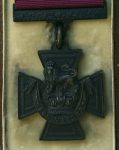
Farther back, ‘D’ Company held out in Racecourse Redoubt until that evening. During the attacks there in the morning, one of ‘D’ Company’s platoon commanders, Second Lieutenant Edmund De Wind, defended his position most gallantly and, assisted by Corporal Samuel Getgood and Lance Corporal Hubert Walker MM, repeatedly cleared the enemy from a trench at the west of the redoubt. Around midday De Wind was killed; Getgood and Walker were captured when the redoubt was surrendered that evening. For their gallantry De Wind was posthumously awarded the Victoria Cross and Getgood and Walker were awarded the Distinguished Conduct Medal.

Recently I was able to help a descendent of De Wind put together some of his story, in preparation for a commemorative event in Comber, Northern Ireland, De Wind’s home town prior to his emigration to Canada. It is with his permission that I can show these fabulous photographs of his Victoria Cross. In 2019 Josh De Wind completed a fuller account of his great-uncle’s life—A Crown of Life—which you can read here.[1]


1. (Back) De Wind, J. (2019). A Crown of Life—Edmund De Wind, VC. Self Published.

The East Coast Floods, 1953

As I work on my book about Royal Signals gallantry awards, the news is dominated by accounts of Hurricanes Harvey, Irma, Jose and Katia and the massive earthquake in Mexico. By coincidence, the section that I am writing is about the East Coast Floods of 1953.

Canvey Island, 1953

On 31 January 1953, an extremely heavy storm coupled with a high spring tide led to a devastating natural disaster in the low-lying areas around the North Sea. Sea defences were breached, coastal areas were flooded and ships were lost. Over 2,500 people were killed—1,836 in the Netherlands, 307 in England, 19 in Scotland and 28 in Belgium; 361 people were killed at sea, including 133 on the Larne-Stranraer ferry m.v. Princess Victoria. This was one of the worst natural disasters to hit the region; the rescue work took many days and recovery took many months.

There were numerous acts of gallantry recorded over the period and 102 British awards were made to civilians and military personal, including honorary awards to men of the United States Air Force stationed in East Anglia. These and the meritorious service awards that followed the rescue effort were spread over several editions of the London Gazette, including the Coronation Honours list; the honorary awards were not published. There were more British awards made in the aftermath of this disaster than for any other single, non-warlike event in British history. Continue reading →

‘The Boche had beaten us, and the slaughter terrific.’

The graves of Lieutenant Colonel S J Somerville, the Commanding Officer, and Captain R D Miles, C Company, Brandhoek New Military Cemetery No. 3

Few of the 154 officers and men of the 9th Royal Irish Fusiliers who were killed immediatley prior to or during the attack on 16 August 1917 lie in marked graves—three-quarters are commemorated on the Tyne Cot Memorial, a substantially higher proportion that those killed on 1 July 1916 who are commemorated on the Thiepval Memorial. There are four primary reasons for this: firstly, very few bodies could be recovered immediately after the action from the area over which the Battalion had attacked; secondly, the area was subjected to continued severe shelling and was not captured until over a month later, by which time many of the bodies were destroyed; thirdly, in early 1918 a narrow gauge railway was built over the area from which the attack was launched, and, fourthly—in consequence—few of the bodies were identified by name in the post-war battlefield clearance.

When the heavy rain began on 31 July 1917, the men of the 9th Royal Irish Fusiliers were at Watou, seven miles west of Ypres preparing for the forthcoming offensive. On 2 August, the Battalion was ordered forward with 13th Royal Irish Rifles and two battalions from 109th Brigade to take over a reserve position in the trenches from which 55th (West Lancashire) Division had attacked on the first day of the battle. This period in the line was short but exhausting, spent in muddy, partially destroyed and crowded trenches and, in the last few hours as the men began the move back west of Ypres, under gas attack. Miraculously, casualties were few but two men, James Greer from Rathfriland and Isaac Hague from Nottingham, would die of their injuries some days later.[1]

Continue reading →

Sacrifice – New Biographies Published

The Canadian Book of Remembrance showing the entry for Private Lawrence Manning

Three new biographies have been added to the Sacrifice project website:

Private Chester Covell Buck served briefly in England with 202nd (Sportsman’s) Battalion before being sent back to Canada unfit for further duty. He died in Ponoka Asylum Hospital, Alberta, on 7 December 1917 and was buried in Oak Hill Cemetery, Plymouth, Indiana.

Private Lawrence Eugene Manning served in France with 72nd Canadian Infantry Battalion (Seaforth Highlanders of Canada). Greatly affected by his experiences, he took his own life on 9 November 1919 and is buried in Salt Lake City Cemetery, Salt Lake City, Utah.

Second Lieutenant George Albert Ruffridge and Cadet Hugh Barker O’Leary of No. 80 Canadian Training Squadron were killed in a flying accident at Camp Bordon in Canada on 6 May 1918. Ruffridge was buried in Rosedale Cemetery, Montclair, New Jersey.

Cather VC

Geoffrey Cather’s Victoria Cross

One hundred years ago today at Buckingham Palace, King George V presented the Victoria Cross to the families of five recipients who had either died in the act or been killed since. Amongst them was Margaret Cather, the widowed mother of Lieutenant Geoffrey St. George Shillington Cather VC, the Adjutant of the 9th Royal Irish Fusiliers, who had so gallantly died on 2 July 1916 while out rescuing men who had fallen in the attack at Hamel the previous day.[1] When she died in 1939 her effects were left to her other son, Dermot, who later presented the Victoria Cross to the Royal Irish Fusiliers museum, where it resides today.[2]

Continue reading →

Blacker’s Letters – ‘Finis’

When the last commanding officer of the 9th Royal Irish Fusiliers signed off the final page of the Battalion’s war diary on 9 June 1919 he did so with a Gallic flourish – ‘Finis’. That is the word that most readily comes to mind as I write this.

After 444 letters recording the thoughts and comments of Lieutenant Colonel Stewart Blacker, the identification of nearly 300 men and women to whom he referred, and many footnotes to explain events, the Blacker’s Letters project has ended. The project was made freely available to read via the project’s website and on social media.

Blacker’s Letters also contributed to the BBC project Voices 16, and I am very pleased that it has been web-archived by the National Library of Ireland and will be added to the web archive of the Public Records Office of Northern Ireland.